A dialysis centre has very different furniture requirements from a typical hospital ward. Patients may remain in the same position for several hours, several times a week, while staff need continuous access to the patient, dialysis equipment and treatment lines. That makes furniture selection part of the practical design of the treatment environment.
A well-planned dialysis center furniture recliner needs to balance patient comfort, positioning, mobility, cleanability, durability and staff access. The surrounding layout matters just as much. A chair that performs well on its own can still create problems if there is not enough room to move equipment, clean the station or assist a patient.
For hospitals and kidney care centers, the goal is not simply to buy comfortable chairs. It is to create a treatment area where furniture, equipment, staff workflow and infection-control practices work together.
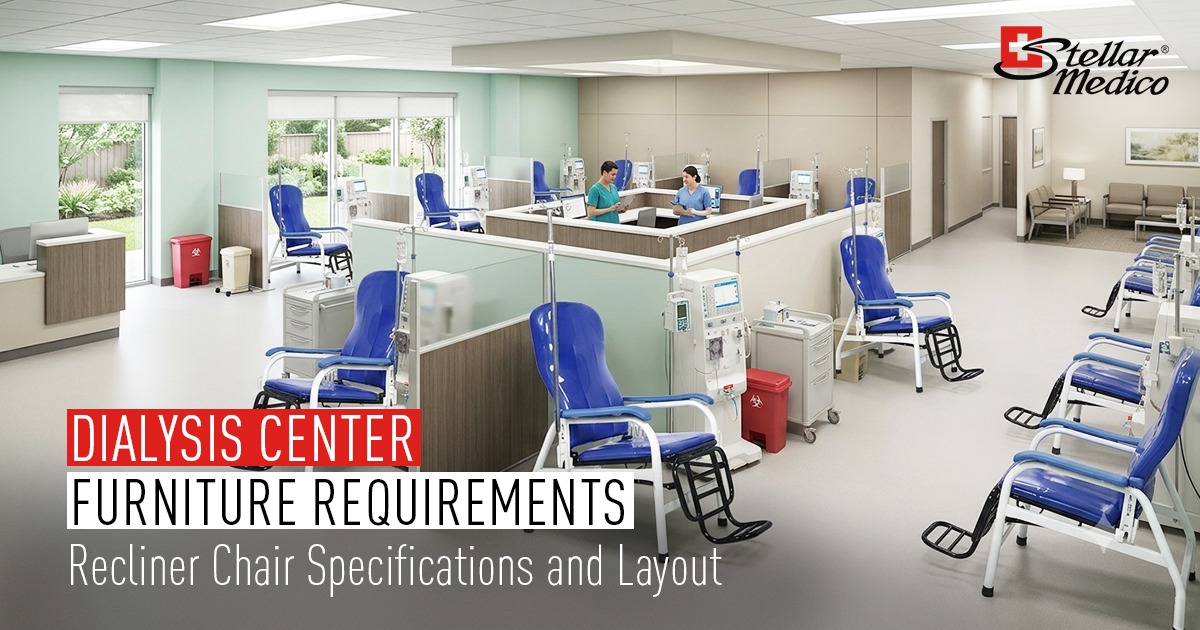
A dialysis station is more than a chair. It brings together the patient seat, dialysis machine, treatment accessories and the space needed for staff to provide care. CDC guidance includes the dialysis bed or chair, countertops, machine surfaces and patient-zone floor among the surfaces requiring cleaning and disinfection.
That makes the dialysis center furniture recliner one of the most frequently used pieces of furniture in the unit. It may be adjusted, moved, cleaned and reused repeatedly throughout the day. Good dialysis furniture therefore needs to be selected around the realities of high-cycle clinical use.
For kidney care centers, this means considering how a chair fits into the complete treatment station rather than evaluating it as an isolated seating product.
The starting point is patient positioning. Dialysis sessions can last for hours, so the chair should allow appropriate reclining and leg positioning while providing stable support.
A suitable dialysis center furniture recliner should provide smooth adjustment, dependable locking or braking where mobility is provided, adequate weight capacity and practical access for staff. The exact recliner specifications should be matched to the clinical use, patient population and equipment planned for the station.
Comfort matters, but it should not come at the expense of cleanability or access. In dialysis furniture, these requirements have to work together.
There is no single specification that makes a chair appropriate for every facility. Procurement teams should review recliner specifications according to the treatment model and room layout.
Important points include overall dimensions, seat width and height, weight capacity, backrest and leg-rest movement, frame construction, caster and brake design, upholstery characteristics and accessory compatibility. For powered models, teams should also review controls, electrical requirements and emergency-positioning provisions where applicable.
These recliner specifications should be documented clearly before procurement. A detailed review also helps facilities compare products consistently instead of choosing primarily on appearance or price.
Dialysis areas have demanding cleaning requirements. CDC guidance recommends cleaning and disinfecting dialysis station surfaces, including the chair or bed, between patients.
This makes surface selection an important part of dialysis furniture procurement. Upholstery should be suitable for repeated cleaning with the disinfectants used by the facility. Surfaces should also avoid unnecessary seams, gaps or difficult-to-reach areas where practical.
For kidney care centers, this is more than a maintenance preference. Furniture needs to support established infection-prevention procedures. Compliance with applicable cleaning and infection-control requirements should therefore be considered alongside product specifications.
A dialysis recliner may need to be repositioned for cleaning, patient transfers, room changes or equipment access. Casters can make this easier, but mobility must be balanced with stability.
A dialysis center furniture recliner with appropriate lockable casters can help staff move the chair when necessary and secure it during treatment. Handles or transfer-support features may also be useful depending on the chair design and patient population.
The important point is that mobility should support the workflow, not create another safety concern. Recliner specifications should therefore be reviewed alongside the way staff actually move patients and equipment through the unit.
A dialysis patient may spend several hours in the same chair, making ergonomics a practical requirement rather than a luxury. Adequate cushioning, adjustable positioning and lower-body support can make prolonged sitting more tolerable.
A well-designed dialysis center furniture recliner should allow the patient to change position within the limits appropriate to treatment. Pressure redistribution can also be relevant for patients who spend long periods seated.
Before placing a large order, hospitals should ideally evaluate sample chairs under realistic conditions. Staff can assess adjustment controls, patient transfers, cleaning access and overall comfort rather than relying only on catalogue images.
Furniture selection and layout should be considered together. Published FGI guidance for renal dialysis centres includes treatment-area and clearance provisions, although exact requirements depend on the applicable edition, jurisdiction and project.
The practical lesson is simple: do not calculate space from chair dimensions alone. Allow room for the dialysis machine, staff movement, patient transfers, cleaning and required accessories.
A dialysis center furniture recliner that looks compact on a product sheet may require considerably more usable space once positioned with the rest of the treatment station.
This is why dialysis furniture should be assessed in the context of the complete room layout.
Open dialysis treatment areas can support staff observation and efficient workflows, but patients still need appropriate privacy. FGI guidance states that open treatment areas should provide privacy for individual patients.
This makes layout planning particularly important in kidney care centers. Screens, curtains or other privacy measures should not obstruct staff access, emergency movement or necessary observation.
The ideal dialysis furniture arrangement therefore balances visibility with dignity. That balance should be considered before fixed partitions or furniture positions are finalised.
Cleaning is not something that happens after the layout is complete. The arrangement itself can make cleaning easier or harder.
CMS guidance states that a dialysis station should be vacated before staff clean and disinfect it between patients, while CDC guidance calls for cleaning and disinfection of the station and patient-zone surfaces.
This means the dialysis center furniture recliner should be positioned so staff can reach relevant surfaces and move cleaning equipment through the station. Furniture should not create hidden corners or unnecessary obstructions.
Compliance should be assessed against the regulations and infection-control practices applicable to the facility rather than assumed from a furniture product alone.
A dialysis unit runs through repeated cycles of setup, treatment, observation, cleaning and preparation for the next patient. Furniture that makes any of these steps unnecessarily difficult can affect the efficiency of the whole unit.
Staff need access to the patient, dialysis machine, supplies and controls without repeatedly working around the chair. This is why dialysis furniture should be assessed from the caregiver’s side as well as the patient’s.
For kidney care centers, a useful test is to walk through a complete treatment cycle before finalising the layout. Where does the nurse stand? Can equipment be reached? Can the chair be moved? Can the station be cleaned efficiently?
Dialysis recliners are used repeatedly and cleaned frequently. Frames, joints, casters, actuators and upholstery can therefore experience significant wear over time.
A dialysis center furniture recliner should be evaluated for expected cycle use, construction quality, maintenance requirements and availability of replacement components. The lowest purchase price may not represent the lowest lifecycle cost if a chair requires frequent repairs or early replacement.
The same principle applies to powered models. Electrical and mechanical components should be supported by a clear maintenance plan, while facilities should understand what service support is available.
A practical layout starts with the treatment station and expands outward. First determine the chair position, dialysis machine location and staff access. Then consider circulation routes, handwashing facilities, storage, privacy provisions, emergency access and cleaning movement.
The final arrangement should reflect the actual number of stations and operational model of the unit. Layout requirements should be checked against local building, healthcare, fire-safety and infection-control requirements rather than copied from another facility.
Procurement teams can then use the approved layout to confirm that the selected dialysis center furniture recliner fits the intended space without compromising movement or access.
Before selecting a chair, procurement teams should ask:
These questions connect product selection with real clinical use and make supplier discussions more specific.
Choosing furniture for a dialysis unit requires attention to both product details and the environment in which those products will be used. Stellar Medico supplies medical furniture solutions for healthcare environments and has published guidance on dialysis recliners covering moisture resistance, mobility, ergonomics, cleaning and high-cycle use.
As a medical furniture supplier, we support healthcare facilities looking for dependable furniture solutions suited to demanding clinical environments. If you are setting up or upgrading a dialysis unit, connect with us to discuss your furniture requirements and source solutions designed to support patient comfort, staff workflow and reliable day-to-day use.
There is no single feature that suits every dialysis unit. A good chair should provide appropriate positioning, stability, cleanable surfaces, sufficient weight capacity and practical staff access. Its recliner specifications should be matched to the treatment model and patient population.
Space depends on applicable building standards, equipment and facility layout. Published FGI guidance includes minimum treatment-area and clearance provisions, but these should not be treated as a universal rule for every jurisdiction or project. Project teams should confirm the requirements applicable to their facility.
Dialysis stations require regular cleaning and disinfection because patients and staff repeatedly share the treatment environment. CDC guidance specifically includes chairs or beds and other station surfaces in cleaning procedures. Furniture should therefore tolerate the disinfectants used by the facility and support its infection-control practices.
Wheels can be useful when chairs need to be repositioned for transfers, cleaning or equipment access. However, mobility should be paired with reliable braking and a stable design. The decision should reflect the unit’s workflow, patient needs and applicable compliance requirements.
The choice depends on clinical needs, patient population, workflow and maintenance resources. Powered adjustment can make positioning easier in some settings, while manual designs may offer simpler operation. Hospitals should assess both options using their actual treatment workflow before procurement.
Social Sharing: