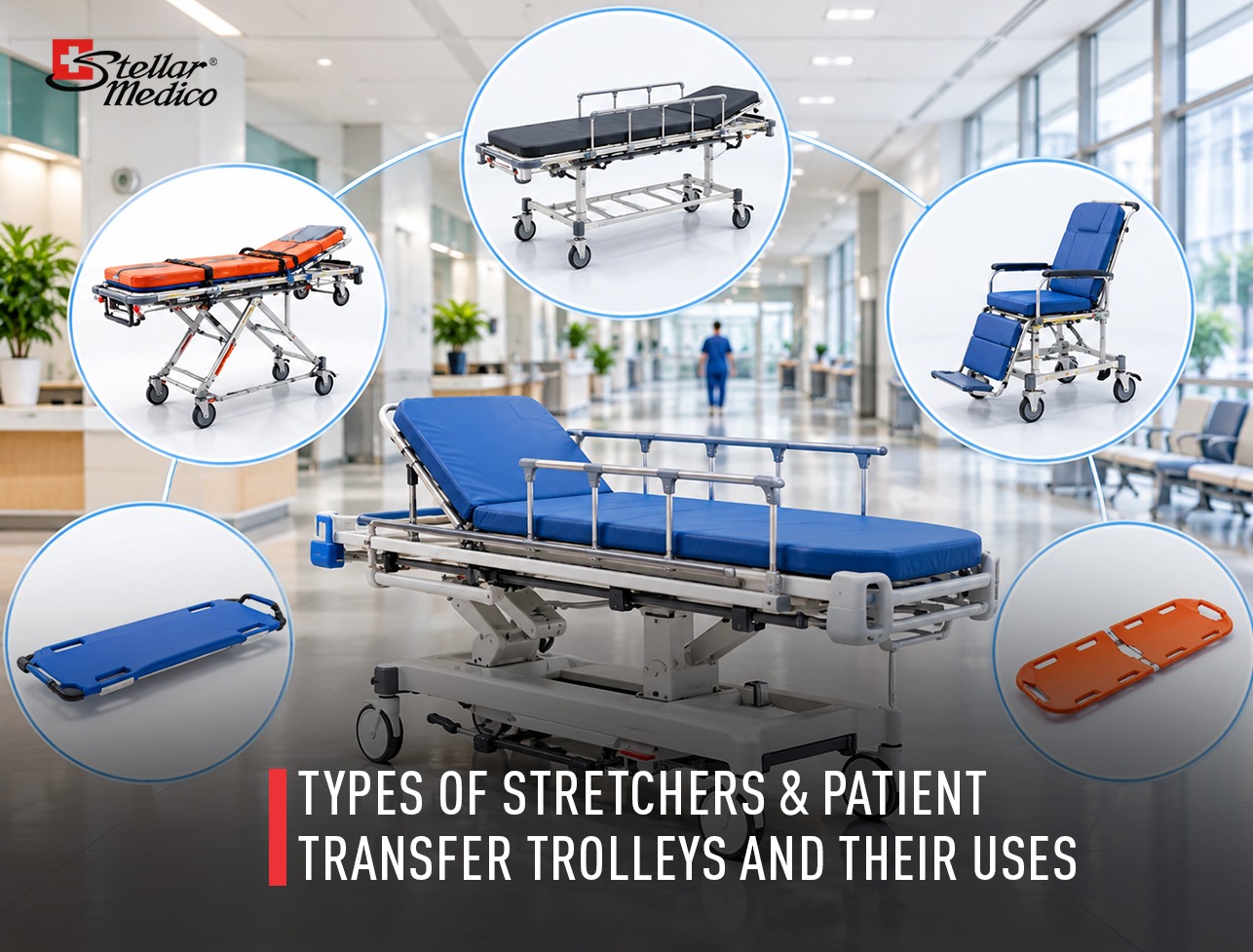
Healthcare facilities need suitable equipment for patient transport across wards, emergency departments and ambulances. From routine transfers to emergency situations, the equipment used can make a difference to patient comfort, accessibility and workflow.
Understanding stretcher designs and patient transfer trolleys helps buyers identify what works for each setting. Some support emergencies; others suit interdepartmental transfers or restricted spaces. Choosing the right stretcher trolley means considering the patient’s needs, the distance involved, available space and the features required by the healthcare team. For urgent situations, an emergency stretcher may be required.
A stretcher is a patient-support surface designed to transport people who cannot walk or need to remain in a lying or supported position. A patient transfer trolley generally combines this surface with a wheeled frame, allowing patients to be moved within a healthcare facility.
The terms are sometimes used interchangeably, although designs and applications differ. A portable stretcher may be carried, while a wheeled stretcher trolley moves along hospital corridors.
Features may include adjustable backrests, side rails, locking castors and accessory holders. A hydraulic model uses a mechanism to adjust platform height.
Among the common types of stretchers, wheeled models move patients between wards, emergency departments, diagnostic areas and treatment rooms. Their wheeled frames make in-facility transport easier than carrying a portable stretcher.
A standard stretcher trolley may include a mattress, side rails, castor wheels and brakes. Some models also have an adjustable backrest to support different patient positions. These features make a stretcher trolley practical for routine transfers.
Buyers should check platform dimensions, wheel movement, brakes, patient capacity and cleanability. Shortlisting hospital furniture suppliers should include reviewing these specifications.
A hydraulic stretcher uses a hydraulic mechanism to raise or lower its patient platform. This allows healthcare staff to adjust the working height according to the transfer or examination requirement.
Height adjustment can help with bed-to-trolley transfers. A hydraulic stretcher may suit emergency departments and examination areas. Buyers should assess its adjustment range, stability, capacity, maintenance needs and suitability for the intended setting. Comparing medical furniture suppliers is also useful when evaluating available models.
An emergency stretcher is designed for situations where patients need to be moved promptly, including transport to or from an ambulance. The emergency stretcher should match the response team’s transport requirements. Ambulance stretchers commonly have a folding or collapsible undercarriage that allows the unit to be loaded into and removed from the vehicle.
Features may include adjustable backrests, restraints and locking arrangements compatible with ambulance loading systems. Not every hospital stretcher is suitable for this purpose.
When evaluating an emergency stretcher, check the ambulance’s dimensions and loading arrangement, along with the stretcher’s stated patient capacity and operating instructions. An emergency stretcher must also be compatible with the vehicle’s loading system.
A suitable stretcher trolley can support movement between the incident location, ambulance and receiving facility, but safe operation depends on trained personnel following the prescribed procedures. The emergency stretcher should be operated only by trained personnel.
Patient movement is not always possible through a spacious corridor or lift. In buildings with narrow staircases, limited access or no suitable lift, a stair stretcher may be considered for moving patients between floors.
They help attendants move supported patients along stairways and may feature tracks, wheels, handles and restraints.
A stair stretcher addresses access challenges, not routine ward transport. Among the specialised types of stretchers, stair models may be relevant to emergency response teams and facilities with restricted access. Buyers should assess staircase dimensions, equipment weight, patient capacity and the training required for operation. Healthcare furniture suppliers should clearly identify the intended application of each model.
A chair stretcher supports patients in a seated position during movement. It can be useful in places where moving a patient on a conventional horizontal stretcher is difficult, such as narrow corridors, staircases or confined spaces.
It may be foldable, with handles, wheels or restraints, making it easier to manoeuvre where a full-length stretcher is impractical.
A chair stretcher is not a regular wheelchair; selection should reflect the patient’s condition and the equipment’s intended use.
A scoop stretcher, also called a split or orthopaedic stretcher, separates into two sections. The sections can be positioned on either side of a patient and brought together to support lifting with minimal rolling.
This design may be used when moving patients with suspected spinal or other serious injuries. The decision to use this equipment and the transfer technique must be determined by trained emergency or clinical personnel.
Assess a scoop model’s locking mechanism, length adjustment, capacity and compatibility.
Vertebral or spinal stretchers are designed to support patients when a spinal injury is suspected. They are associated with emergency response and patient extrication, where maintaining appropriate support during movement is important.
They may be used alongside other equipment under established patient-handling protocols. Trained responders determine the appropriate equipment and method.
A vertebral stretcher is not a general-purpose trolley. Review its application, construction, dimensions and compatibility. The same careful review applies when comparing patient beds and accessories suppliers.
Among the portable types of stretchers, foldable models are designed to become more compact for storage and transport. They may be considered by emergency response teams, ambulance services, temporary medical facilities and organisations that need portable equipment.
Portable models may have lightweight frames and handles. Suitability depends on load capacity, material, dimensions and transport distance.
These types of stretchers offer flexibility where a wheeled trolley is impractical, but buyers must check specifications and intended use.
Choosing a patient transfer trolley involves more than comparing prices. Consider its use, operators and transport environment.
Patient movement is central to hospital operations. Suitable equipment supports transfers between departments and planned examinations.
For example, a hospital may need a wheeled trolley for routine transfers, a hydraulic stretcher for adjustable working heights and an emergency stretcher for ambulance-related requirements. A facility with limited stair access may also need specialised equipment for movement between floors.
No single model suits every situation. Selecting the right stretcher trolley means matching its design and specifications to the facility’s needs, while ensuring staff follow appropriate patient-handling procedures.
Selecting stretchers is part of equipping functional healthcare spaces. Buyers should compare specifications and match products to facility requirements.
As one of the medical furniture suppliers serving healthcare buyers, Stellar Medico offers stretcher options including hydraulic, ambulance, stair, chair, vertebral, shovel and fold stretchers. Healthcare facilities can explore the available range and enquire about models suited to their requirements. International procurement teams comparing hospital equipment suppliers China should also verify product details and suitability.
Looking to source stretchers for your hospital, clinic or healthcare facility? Explore our stretcher range and connect with the team to discuss your medical furniture requirements.
Social Sharing: