In today’s healthcare industry, certifications have become a major deciding factor when hospitals choose their infrastructure. Among these, ISO certification is often seen as a mark of quality and reliability. Many procurement teams assume that if a product is labeled as ISO certified medical furniture, it automatically meets the highest safety standards.
But is that always true?
The reality is more nuanced. While ISO certifications play an important role in ensuring quality systems, they do not always guarantee that every product is inherently safe or suitable for hospital environments.
Understanding what ISO certification actually means and what it doesn’t can help healthcare facilities make better, more informed decisions.
ISO or the International Organization for Standardization, develops standards that help organizations maintain consistency, quality and efficiency in their processes.
When a product is marketed as ISO certified medical furniture, it often means that the medical furniture manufacturer follows a standardized quality management system. This certification ensures that processes are documented, monitored and improved continuously.
However, ISO certification does not always certify the product itself. Instead, it validates the processes used by the medical furniture manufacturer. This distinction is critical because it means the certification is about how something is made, not necessarily how safe or effective the final product is.
This is why hospitals must look beyond labels and evaluate whether the furniture truly qualifies as certified medical furniture in terms of performance and safety.
Also Read: Key Documents Needed for Medical Furniture Imports: A Retailer’s Checklist
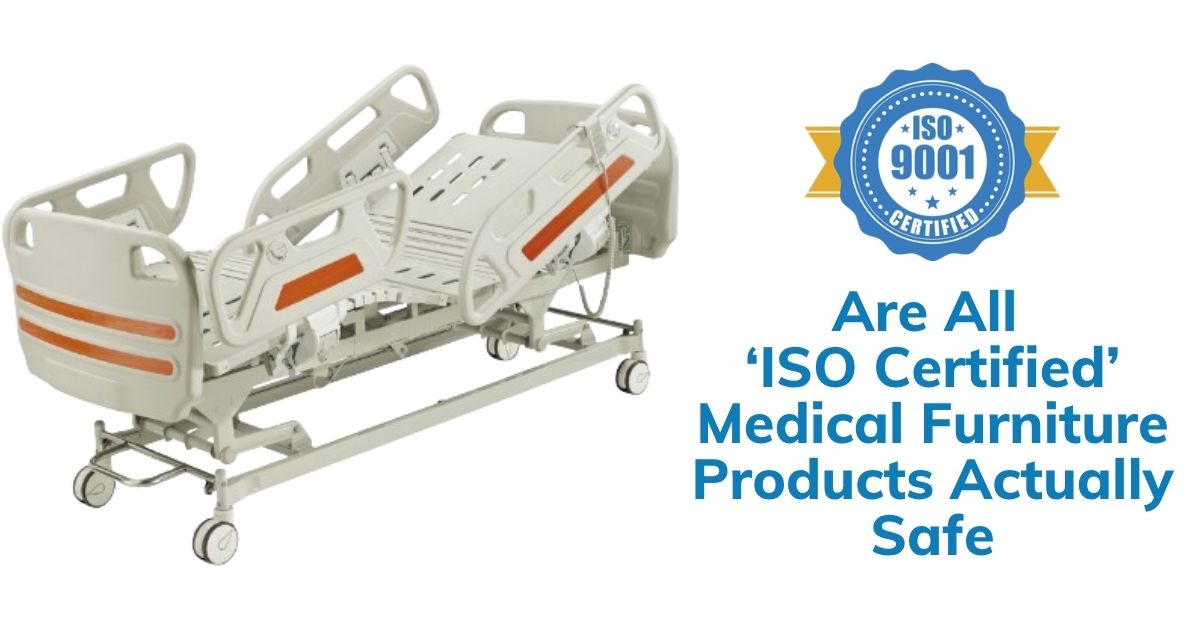
One of the biggest misconceptions in healthcare procurement is assuming that all ISO certified medical furniture is automatically safe for use in critical environments.
In reality, ISO certification alone does not confirm structural strength under continuous use, resistance to hospital-grade disinfectants, fire safety compliance or ergonomic suitability for patients and staff.
A medical furniture manufacturer may have ISO certification but still produce products that do not meet specific clinical requirements.
This is why experienced buyers focus on verifying whether the product itself meets healthcare standards, not just whether the manufacturer holds certification.
Understanding this difference helps hospitals avoid relying solely on the label of certified medical furniture without deeper evaluation.
Also Read: How to Choose the Right Medical Furniture for High-Traffic Hospital Areas
To fully understand the limitations of ISO certification, it’s important to differentiate between process certification and product certification.
ISO certifications typically focus on processes. They ensure that a medical furniture manufacturer follows consistent production methods, maintains documentation and implements quality checks.
However, product safety depends on additional factors such as:
This means that while ISO certified medical furniture may come from a well-managed system, it does not automatically guarantee that the product is clinically safe.
Hospitals must ensure that products qualify as certified medical furniture through performance validation, not just certification claims.
Also Read: How Suppliers Help Hospitals Maintain Hygiene & Safety
Healthcare environments are highly demanding. Furniture is exposed to constant use, heavy loads and repeated cleaning cycles. Relying only on ISO certified medical furniture can create gaps in safety if other critical factors are ignored.
Hospitals must evaluate:
A reliable medical furniture manufacturer understands these demands and designs products accordingly.
This approach ensures that hospitals invest in certified medical furniture that truly performs under real-world conditions.
Material selection plays a crucial role in determining the safety and durability of hospital furniture. Even if a product is marketed as ISO certified medical furniture, poor material choices can lead to:
This is why leading medical furniture manufacturer practices focus on using materials that are corrosion-resistant, non-porous and easy to clean.
True certified medical furniture must combine process quality with material performance to meet healthcare expectations.
Also Read: What Are Fire-Resistant & Chemical-Resistant Materials in Medical Furniture?
Testing is one of the most critical aspects of ensuring medical furniture safety.
While ISO standards ensure process consistency, hospitals must verify whether ISO certified medical furniture has undergone real-world testing for load-bearing capacity, stability and mobility, resistance to cleaning agents and durability under continuous use.
A responsible medical furniture manufacturer and supplier conducts rigorous testing to ensure products perform reliably in hospital environments.
Without proper validation, even products labeled as certified medical furniture may fall short in practical use.
Infection control is a major concern in healthcare facilities. Furniture surfaces must support regular cleaning and prevent bacterial accumulation.
ISO certification alone does not guarantee that the medical furniture meets infection control standards.
Hospitals must check whether the furniture has seamless surfaces, is resistant to disinfectants and prevents microbial growth.
An experienced medical furniture manufacturer prioritizes these features to ensure hygiene compatibility.
Only then can products truly qualify as certified medical furniture suitable for modern healthcare environments.
Also Read: Why Is Infection-Control Furniture Essential for Hospitals?
Hospitals must comply with strict fire safety regulations. Furniture used in clinical areas must resist ignition and limit fire spread.
However, ISO certified medical furniture does not automatically guarantee fire resistance.
Healthcare facilities must ensure that the furniture meets fire safety requirements in addition to ISO certification.
A trusted medical furniture manufacturer incorporates fire-resistant materials and designs into their products.
This ensures that certified medical furniture supports both operational safety and regulatory compliance.
To make informed procurement decisions, hospitals must verify certification claims carefully.
When evaluating iso certified medical furniture, it is important to understand whether the certification applies to the product or just the company, check the validity and issuing authority of the certificate and review supporting test reports and compliance documents.
A transparent medical furniture manufacturer provides clear documentation and product-specific validation, helping buyers make confident decisions.
However, in practice, many healthcare facilities streamline this process by working with a trusted medical furniture supplier who already ensures that the furniture being sourced meets required standards and certifications.
This approach reduces the burden of individual verification while still ensuring that hospitals invest in genuinely certified medical furniture rather than relying solely on marketing claims.
Selecting the right supplier is just as important as choosing the right product.
Hospitals and healthcare facilities should work with a medical furniture supplier who understands clinical requirements and provides reliable, durable solutions.
Experienced suppliers ensure that ISO certified medical furniture is supported by strong material selection, proper testing and validation and compliance with healthcare standards.
This ensures that hospitals and medical facilities receive certified medical furniture that performs consistently in demanding environments.
ISO certification is an important benchmark in the healthcare industry, but it is not a complete measure of product safety.
While ISO certified medical furniture indicates structured manufacturing processes, hospitals must go beyond this label to evaluate real-world performance, durability and compliance.
True safety comes from a combination of quality materials, proper testing and thoughtful design and not just certification.
Stellar Medico understands the importance of delivering reliable healthcare infrastructure.
As a trusted supplier, we focus on providing high-quality medical furniture that meets the practical needs of hospitals and healthcare facilities.
If you are looking to equip your healthcare space with dependable solutions, choose a partner who values performance as much as certification.
Connect with us today and source medical furniture designed to support safety, durability and efficiency in modern healthcare environments.
1. Are all ISO certified medical furniture products safe to use?
Not necessarily. ISO certification ensures that a manufacturer follows standardized processes, but it does not always guarantee product safety. Hospitals must evaluate materials, testing, and compliance to ensure the furniture meets clinical requirements.
2. What does ISO certification mean for medical furniture?
ISO certification typically indicates that a manufacturer follows a quality management system. It ensures consistency in production processes but does not always certify the safety or performance of the final product.
3. How can hospitals verify certified medical furniture?
Hospitals should check product-specific certifications, test reports and compliance documents. It is important to confirm that the certification applies to the actual product and not just the manufacturer.
4. Why is choosing the right medical furniture manufacturer important?
A reliable medical furniture manufacturer ensures that products meet healthcare standards, use durable materials and undergo proper testing. This helps hospitals maintain safety and efficiency in their operations.
5. What factors should hospitals consider beyond ISO certification?
Hospitals should consider material quality, durability, infection control compatibility, fire safety and real-world performance. These factors ensure that medical furniture is safe and reliable for long-term use.
Social Sharing: