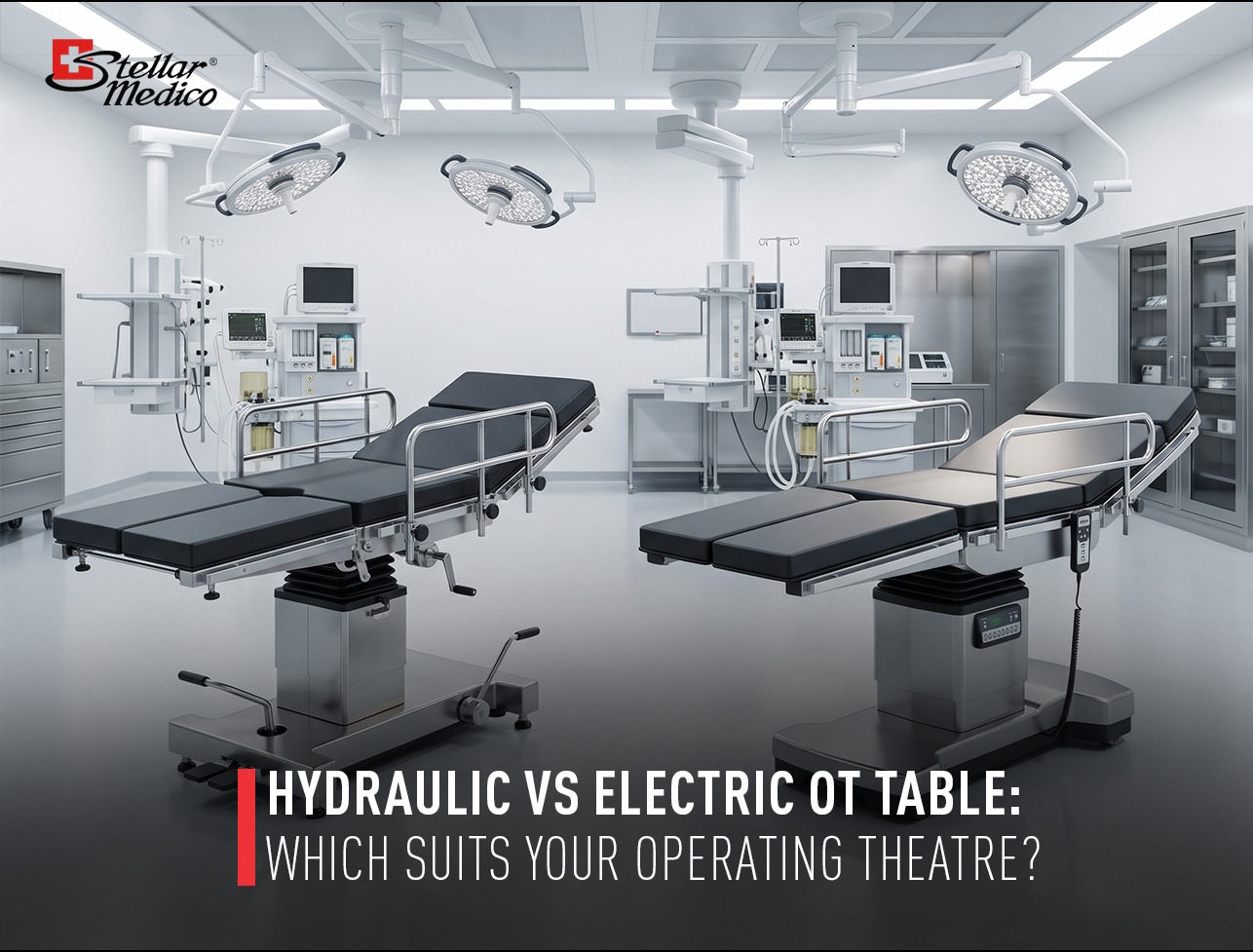
An operating table supports the patient throughout surgery and allows the team to achieve the required position. Since procedures differ, choosing one calls for more than comparing models or prices.
One of the key decisions for hospital buyers is whether to choose a hydraulic or electric operating table. Both provide a stable platform, but their adjustment mechanisms and operating requirements differ. Understanding these differences helps buyers match a table to their theatre and resources.
A hydraulic OT table uses a hydraulic mechanism to perform certain adjustments, commonly through a foot-operated pump or lever system. The operator uses the mechanism to raise or lower the table or adjust selected sections, depending on the model.
An electric operating table uses powered actuators and electrical controls for specified movements. These may be operated through a hand remote or a control panel, allowing staff to adjust the table without manually pumping a mechanism.
There is also an important third category: the electro-hydraulic table. It uses an electric pump and controls to operate hydraulic cylinders. In other words, it combines electrical control with hydraulic movement. Buyers should check the actual drive system rather than assuming every electrically controlled table is fully electromechanical.
A hydraulic OT table relies on fluid pressure to produce movement. In manually operated models, a foot pedal or pump creates the pressure needed to raise the platform. Depending on the design, other functions may be adjusted using levers or manual controls.
A hydraulic OT table may suit facilities needing essential positioning without electrical power for every adjustment. Its mechanism can be straightforward, but still requires maintenance.
Before selecting a hydraulic OT table, buyers should check which movements are hydraulically operated and which require manual adjustment. They should also review the height range, positioning options, stability, load capacity and service requirements. The term hydraulic alone does not confirm the full set of functions available.
An electrically powered model uses motors or linear actuators to power selected movements. Depending on its configuration, controls may adjust height, tilt and sections of the tabletop. Some models offer remote operation, memory positions or one-touch return functions.
These controls can make frequent positioning adjustments more convenient, without manually pumping the table.
Functions vary by model; certain head or leg sections may still require manual adjustment. Buyers should confirm which movements are powered.
The key difference is how movements are produced: manual hydraulic systems use a pump and fluid pressure, an electric operating table uses actuators and electro-hydraulic designs use electrical controls to operate hydraulic mechanisms.
Ease of adjustment: An electric operating table can reduce the physical effort involved in making powered adjustments. A manually operated hydraulic model requires staff to use its pump or levers for the relevant movements.
Power dependency: A manual hydraulic table can perform its hydraulically operated functions without mains electricity. An electric operating table depends on its power system, although some configurations include rechargeable batteries or backup controls. Confirm the backup arrangement rather than assuming it is standard.
Positioning functions: Both categories can offer height adjustment and patient positioning, but the range differs by model. The powered model may provide tilt, tabletop movement or preset positions, while a basic hydraulic design may offer fewer powered functions.
Maintenance: Hydraulic systems require attention to fluid levels, seals, hoses and possible leaks. Electric systems require checks of actuators, controls, cables and batteries where fitted. Neither type is maintenance-free, and the manufacturer’s service schedule should guide upkeep.
Operating environment: A high-volume theatre with frequent positioning changes may benefit from powered controls. A facility with simpler requirements or limited access to electrical supply may consider a manual hydraulic model, provided its functions meet clinical needs.
The best choice depends on procedures, usage frequency and positioning needs. Understanding operation theatre table types helps buyers compare equipment by application.
A general-purpose operating theatre may need a table that supports common surgical positions and routine adjustments. A manual hydraulic model may be sufficient where the required functions are straightforward and the team is comfortable operating the mechanism.
A busy theatre with frequent changes in patient position may find an electric operating table more convenient. This is one reason buyers compare operation theatre table types against actual workflow. Powered adjustments can support workflow when the model offers the required movements and control access.
Specialties such as orthopaedics, neurosurgery, urology and gynaecology may require particular positioning features, accessories or imaging compatibility. For example, C-arm procedures may call for a radiolucent tabletop and suitable longitudinal movement. These requirements should be checked against the actual product specification.
When comparing operation theatre table types, avoid assuming that one drive system automatically makes a table suitable for a specialty. The configuration, tabletop design, accessories, load capacity and positioning range matter just as much.
OT table price varies with the drive mechanism, construction, features, accessories and supplier terms. A lower quote may not offer long-term value if essential functions are missing.
List the procedures the table must support, then compare height range, tilts, back and leg adjustments, tabletop movement and safe working load. Check which functions are manual, hydraulic or electric.
When reviewing OT table price, also account for included accessories, installation requirements, warranty coverage, service availability and replacement parts. Confirm whether batteries, remote controls, mattresses, restraints and specialty attachments are included or quoted separately.
A detailed comparison of OT table price should be based on equivalent specifications. Buyers may consult hospital furniture suppliers for comparable quotations. And they should also clarify what the quoted OT table price includes.
An operating table must suit repeated use. Before procurement, check floor space, access routes, power requirements and compatibility with other theatre equipment.
A hydraulic OT table needs appropriate inspection of its hydraulic components, including seals and connections. Any signs of leakage, unusual movement or difficulty maintaining a position should be addressed by qualified service personnel.
An electric operating table requires checks of its control system, actuators, cables and battery backup, if available. Staff should know how to use the controls and follow the manufacturer’s instructions for emergency operation.
For either system, cleaning procedures should be compatible with the table’s surfaces and materials. Preventive maintenance, timely servicing and proper use help support reliable operation over the equipment’s working life.
Patient beds and accessories suppliers may offer adjacent product categories, but OT table requirements should be assessed separately.
There is no universal winner in the hydraulic-versus-electric comparison. A manual hydraulic model may suit a theatre with essential positioning needs and a preference for reduced dependence on electrical controls. An electric model may be more appropriate where frequent powered adjustments, convenience and specific positioning features are priorities.
Begin with clinical and operational needs, then review specifications, service support and ownership costs. When speaking with hospital furniture suppliers, procurement teams should also consult the operating staff who will use the table, since their experience can reveal practical requirements that may not be obvious from a catalogue.
When shortlisting operation theatre table types, compare the actual functions and configurations rather than relying only on the category name. A clear understanding of operation theatre table types also helps avoid paying for features the facility may not need. Ask medical equipment furniture suppliers for product documentation and clarification wherever specifications are unclear.
An operating table must suit the procedures, space and daily demands of the theatre. Comparing features, mechanisms, maintenance and cost helps hospitals make an informed selection.
At Stellar Medico you will find a dedicated range of OT tables and multiple listed models for operating rooms. Healthcare buyers can explore the available options. Healthcare furniture suppliers should be assessed on product information and responsiveness as well as range.
For overseas buyers comparing hospital equipment suppliers China, product documentation and configuration should be checked carefully. If your hospital is evaluating a new operating table, explore the OT table range at Stellar Medico and connect with the team to discuss your medical furniture requirements.
Social Sharing: