Planning a hospital is one of the most significant investments any healthcare organization can make. While construction, medical equipment and staffing often receive immediate attention, furniture is equally critical because it directly influences patient care, staff efficiency, safety and long-term operational performance. The challenge many hospitals face is not simply choosing furniture, but accurately estimating the hospital furniture cost before procurement begins.
A realistic furniture budget helps healthcare facilities avoid cost overruns, phase purchases intelligently and align procurement decisions with operational priorities. Whether you’re developing a small clinic, a mid-sized specialty hospital or a large multi-specialty medical center, understanding the major cost drivers is essential for effective budget planning.
In this guide, we’ll break down the components of a hospital furniture budget calculator, explain how furniture pricing varies by facility size and show how thoughtful cost estimation can improve financial control throughout the project lifecycle.
Hospital furniture is not a cosmetic purchase. Patient beds, examination tables, nursing stations, waiting area seating, medical trolleys, storage systems and ICU furniture are all operational assets that support healthcare delivery every day. Underestimating hospital furniture cost can delay project completion, force last-minute substitutions, and increase future maintenance expenses.
Effective budget planning allows hospitals to prioritize critical departments, schedule purchases according to construction phases and distribute capital expenditure more strategically. It also provides procurement teams with a clearer framework for evaluating supplier proposals and comparing long-term value rather than focusing only on the lowest upfront price.
A reliable cost estimation process therefore becomes an essential part of healthcare infrastructure planning rather than a simple purchasing exercise.
Before calculating total project budgets, hospitals should understand the four primary cost categories that influence overall hospital furniture cost.
This is usually the largest portion of the furniture budget and includes patient beds, bedside lockers, overbed tables, attendant furniture, stretchers and ward seating. Because these products are used continuously, their furniture pricing is heavily influenced by durability, adjustability, mobility and material quality.
Examination couches, procedure chairs, treatment trolleys, instrument tables and ICU support furniture fall into this category. Specialized departments such as dialysis, emergency care and critical care often increase the overall hospital furniture cost because they require higher-performance products.
Nursing stations, doctor workstations, reception counters, staff seating, storage cabinets and utility furniture contribute to operational efficiency and should be included in early budget planning discussions.
Reception seating, visitor chairs, cafeteria furniture and public area benches are frequently underestimated during cost estimation, even though they represent a significant portion of large hospital projects.
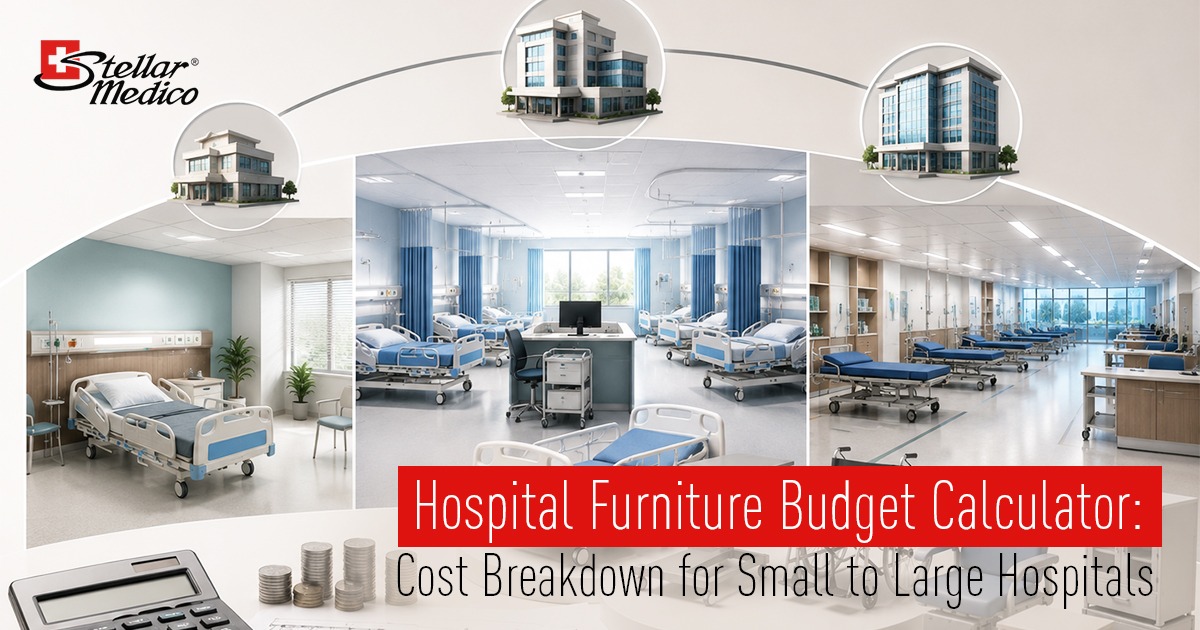
A small hospital or day-care facility generally focuses on essential patient care services, outpatient consultation, minor procedures and limited inpatient capacity. The biggest influence on furniture cost at this scale is the number of patient beds and treatment rooms.
For small facilities, budget planning should prioritize patient beds, examination furniture, nursing stations and waiting area seating before considering premium finishes or additional accessories. Procurement teams often benefit from phased purchasing, where non-critical administrative furniture is acquired after clinical areas become operational.
Because project volumes are smaller, furniture pricing may be less favorable than large institutional purchases. However, careful cost estimation can still prevent unnecessary overspending by standardizing furniture models across departments.
Many smaller healthcare facilities begin vendor evaluation by consulting established hospital furniture suppliers with experience serving clinics and community hospitals.
As hospitals expand into multi-specialty services, the complexity of furniture requirements increases significantly. Additional departments such as operating theatres, ICUs, dialysis units, maternity wards and diagnostic areas introduce specialized furniture categories that affect overall hospital furniture’s cost.
At this stage, structured budget planning becomes much more important. Hospitals should create department-wise furniture schedules, identify standardized product ranges and allocate contingency funds for late-stage additions. A realistic cost estimation should also account for installation logistics, transportation, storage and commissioning support.
Mid-sized projects often benefit from coordinated capital expenditure planning because furniture procurement may occur in multiple phases aligned with construction progress. Standardization across wards and outpatient areas can improve purchasing efficiency and simplify future maintenance.
Healthcare organizations frequently engage experienced medical furniture suppliers during this phase to evaluate product consistency, warranty coverage and long-term availability.
Large tertiary-care and multi-specialty hospitals involve hundreds of patient beds, extensive critical care facilities, multiple nursing stations, specialized treatment areas and significant public infrastructure. In such projects, even small variations in unit furniture pricing can create major differences in total hospital furniture cost.
Comprehensive budget planning for large hospitals typically includes detailed room data sheets, departmental furniture matrices, installation sequencing, inventory management and future expansion allowances. Procurement teams also conduct more rigorous cost estimation exercises to compare standardized product options across large quantities.
At this scale, furniture procurement becomes a substantial capital expenditure category, requiring executive-level review and long-term operational analysis. Decisions are often based not only on purchase price but also on durability, maintenance requirements, replacement cycles and lifecycle performance. Large healthcare networks frequently work with established healthcare furniture suppliers capable of supporting high-volume institutional projects across multiple departments.
One of the most common mistakes in hospital budgeting is focusing only on catalog prices. Several indirect expenses can significantly increase the final cost if they are not included in the original cost estimation.
These hidden costs may include delivery charges, floor-wise transportation, installation labor, temporary storage, packaging disposal, site protection, commissioning support, staff training and future spare parts. Ignoring these elements can create budget gaps even when product prices appear accurate.
Strong budget planning therefore requires procurement teams to evaluate the full cost of ownership rather than only the purchase order value. This approach also improves capital expenditure forecasting by providing a more realistic picture of total project investment.
Hospitals upgrading inpatient wards often coordinate with specialized patient beds and accessories suppliers to ensure bed systems, accessories and support furniture are budgeted together rather than treated as separate purchases.
A useful hospital furniture budget calculator begins with departmental planning rather than a single lump-sum figure. Start by identifying the number of rooms, beds, treatment stations, workstations and public seating positions in each department. Then assign a realistic furniture pricing range for each category based on operational requirements and expected usage intensity.
This method improves cost estimation accuracy because it highlights departments with unusually high furniture requirements, such as ICU, dialysis, emergency or procedure areas. It also allows management teams to compare clinical priorities against available capital expenditure before procurement begins.
Department-wise budget planning is particularly valuable during phased hospital development because furniture purchases can be scheduled according to occupancy targets and cash-flow availability.
Standardizing furniture across wards, consultation rooms, nursing stations and waiting areas is one of the most effective ways to control hospital furniture cost. Using common models reduces procurement complexity, simplifies maintenance and improves inventory management.
Standardization also strengthens budget planning by allowing procurement teams to negotiate better furniture pricing on larger quantities. Replacement planning becomes easier because spare parts, accessories and future purchases remain compatible with existing furniture.
For growing healthcare networks, standardized procurement can significantly improve long-term capital expenditure control while supporting operational consistency across multiple facilities.
Large institutional projects may also consult experienced medical equipment furniture suppliers when integrating furniture with clinical equipment and departmental infrastructure requirements.
Hospitals rarely remain the same size throughout their operational life. Additional beds, new specialties, expanded outpatient services and upgraded critical care facilities can all increase future furniture requirements. A forward-looking budget calculator should therefore include an expansion allowance rather than budgeting only for current occupancy.
Incorporating future growth into cost estimation helps avoid expensive re-procurement later. It also allows hospitals to align current purchases with long-term infrastructure plans, improving both operational continuity and capital expenditure efficiency.
Some healthcare organizations evaluate broader sourcing strategies, including options from hospital equipment suppliers China, when assessing future procurement scalability and project-specific purchasing requirements.
A hospital furniture budget calculator is ultimately a decision-making tool, not just a spreadsheet. By understanding the major drivers of furniture cost, hospitals can create more accurate budgets, reduce procurement surprises and allocate resources where they have the greatest clinical impact. Whether the project involves a small community hospital or a large tertiary-care facility, structured budget planning, realistic furniture pricing, detailed cost estimation and disciplined capital expenditure management are the foundations of successful healthcare infrastructure investment.
As a trusted medical furniture supplier, Stellar Medico supplies a comprehensive range of hospital furniture solutions designed for modern healthcare environments. From patient care areas and nursing stations to specialized clinical departments, we support healthcare facilities with reliable furniture products for projects of every scale.
If you’re planning a new hospital, expansion or renovation, connect with us today and build a smarter, more reliable furniture budget with dependable healthcare furniture solutions.
Social Sharing: