Updated on April 9, 2026, for accuracy and clarity.

In today’s global healthcare landscape, importing high-quality medical furniture from international suppliers offers real advantages—better pricing, access to specialized designs, and advanced manufacturing standards. But with those opportunities come risks.
For hospital procurement heads, healthcare consultants, and B2B buyers, even a small oversight during the sourcing process can lead to compliance failures, shipment delays, budget blowouts, and—most critically—impacts on patient care.
In this blog, we will go through what are the common mistakes people should not ignore when importing medical furniture globally and how to prevent these mistakes before you incur losses.
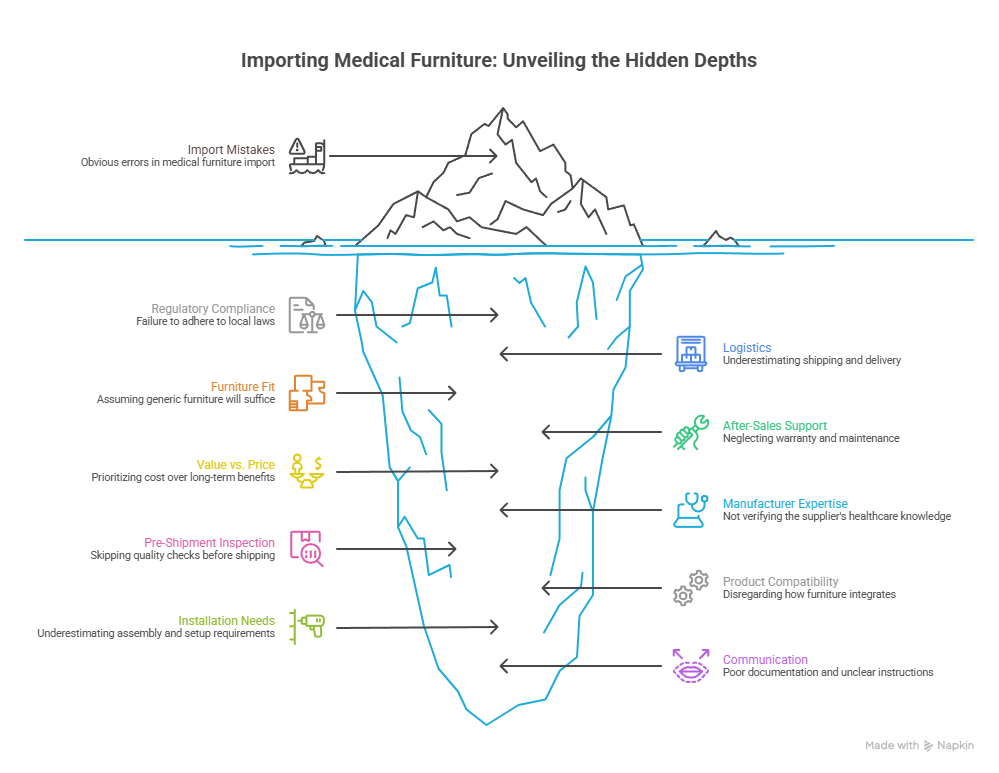
Just because a product looks premium doesn’t mean it’s legal for use in every country. Overlooking country-specific healthcare regulations is a costly mistake. Medical furniture must meet certifications like ISO 13485, CE, or FDA—plus any electrical and safety compliance standards for motorized beds or examination tables.
Failure to comply may lead to delays at customs, fines, or even denial of use in medical settings. Work with hospital furniture suppliers who understand international compliance. At Stellar Medico, our entire product line is pre-certified for export and tailored to meet country-specific import norms.
Importing medical furniture isn’t just about product pricing—it’s about total landed cost. Duties, GST/VAT, freight, insurance, packaging, documentation, and local handling can all pile up. Many projects get delayed because logistics weren’t factored into timelines or budgets.
Partner with hospital furniture suppliers like Stellar Medico who provide full landed cost estimates and handle global logistics. We work with reputable freight forwarders and offer detailed breakdowns (EXW, FOB, CIF, DDP) to avoid last-minute surprises.
Furniture that fits one country’s norms might be completely incompatible elsewhere—whether it’s bed dimensions, plug types, or ergonomic standards.
Beds may be too large for patient rooms, trolleys might not fit elevators, or plug types may not match voltage specs. The smarter approach? Request region-specific customizations and mockups.
Stellar Medico offers modular and customizable medical furniture that adapts to your local needs—be it patient size, spatial layouts, or cultural usage.
Medical furniture isn’t plug-and-play. Without training, manuals, or remote support, even premium equipment can become a liability.
Too often, buyers discover after arrival that there’s no warranty coverage for international shipments, no local servicing, and no user guidance. At Stellar Medico, we offer remote tech support, user manuals, spare parts kits, and warranty coverage tailored for international buyers.
It’s tempting to go with the lowest quote, but in medical settings, cheap often turns out to be expensive. Substandard furniture leads to frequent repairs, safety risks, or early replacement.
Instead of just comparing price tags, look at lifecycle value, warranty support, and long-term usability. Stellar Medico balances cost-effectiveness with build quality, ergonomic design, and global safety compliance—ensuring value, not just savings.
General furniture manufacturers may not understand hospital workflows, infection control protocols, or clinical safety needs. Products may look the part but lack the medical-grade durability, hygiene features, or functional layout.
That’s why it’s critical to source from specialized hospital furniture suppliers. At Stellar Medico, we manufacture exclusively for the healthcare sector—with ISO 9001 and ISO 13485-certified processes, and successful deliveries across Europe, Africa, the Middle East, and Southeast Asia.
Assuming that your order will arrive exactly as planned is risky. Issues like wrong finishes, missing components, or mechanical faults are common in uninspected shipments.
Always insist on third-party inspection or video walkthroughs before dispatch. Stellar Medico provides QC reports, factory inspection videos, and documentation kits to ensure you get exactly what was approved.
Different countries have different plug standards, corridor widths, and workflow styles. Hospital furniture that works in one market may disrupt operations in another.
Always verify compatibility: request specs, electrical details, and layout plans. At Stellar Medico, we adjust sizes, fittings, and finishes to suit regional infrastructure and user expectations.
Medical furniture often requires trained assembly or installation—especially ICU beds, modular nurse stations, or surgical tables. Yet many importers fail to plan for on-site setup.
Stellar medico offer remote installation support, training guides, and supervision options for large-scale projects. Don’t just plan for delivery—plan for full functionality.
Cross-border projects fall apart without clear documentation, timelines, or centralized communication. Misaligned drawings or language barriers can delay production and customs clearance.
Ensure your supplier supports multilingual communication and has experience managing global healthcare equipment procurement. At Stellar Medico, our team offers real-time updates, centralized trackers, and dedicated project managers to avoid gaps and delays.
Global sourcing of medical furniture is no longer just about price—it’s about precision. From regulatory compliance to post-sale support, every step in the healthcare equipment procurement process matters.
Avoiding these common mistakes helps you:
At Stellar Medico, we specialize in export-ready, fully compliant medical furniture for hospitals, clinics and healthcare institutions worldwide. Our portfolio includes:
With 34+ years of experience, CE and ISO certifications, and proven logistics support, we help you supply smarter—so you can focus on delivering care.
Contact Stellar Medico today to discuss your upcoming procurement needs, request a catalog, or get a quote tailored to your region.
1. What are the biggest mistakes to avoid when importing medical furniture?
The biggest mistakes include ignoring compliance, choosing unreliable suppliers, underestimating costs, skipping inspections, and neglecting after-sales support.
Importing medical furniture is a complex process that involves strict regulations and high-quality standards. Many buyers focus only on price and overlook certifications, which can lead to legal issues or unusable products. Others fail to calculate the full landed cost, including logistics and duties. Not inspecting products before shipment or ignoring service support can result in defective equipment and long-term operational problems.
2. Why is regulatory compliance important when importing medical furniture?
Regulatory compliance is important because it ensures the furniture meets safety, quality, and legal standards required in your country.
Medical furniture is often subject to strict healthcare regulations, and non-compliant products can be rejected at customs or prohibited from use. Certifications like ISO or CE indicate that the products are manufactured according to recognized standards. Ensuring compliance protects patient safety, avoids legal penalties, and ensures smooth import clearance.
3. What hidden costs should I consider when importing medical furniture?
Hidden costs include shipping, customs duties, taxes, insurance, warehousing, and last-mile delivery charges.
Many importers only consider the product price and overlook additional expenses that significantly increase the total cost. These may include port handling fees, documentation charges, currency fluctuations, and unexpected delays. Accurately calculating the total landed cost helps in budgeting properly and avoiding financial surprises.
4. How do I choose the right medical furniture supplier for import?
You should choose a supplier with proven experience, proper certifications, quality assurance processes, and reliable after-sales support.
A good supplier understands international healthcare standards and has experience exporting to multiple countries. Look for verified manufacturing capabilities, client reviews, and product testing procedures. Communication, customization options, and the ability to provide documentation are also key factors when selecting a trustworthy partner.
5. Is it risky to choose the cheapest medical furniture option?
Yes, choosing the cheapest option is risky because it often compromises quality, durability, and safety.
Low-cost products may use inferior materials or lack proper certification, which can lead to frequent breakdowns and safety hazards. In the long run, repair, replacement, and downtime costs can exceed the initial savings. It is better to focus on value, reliability, and compliance rather than just the lowest price.
6. Why is pre-shipment inspection important in medical furniture imports?
Pre-shipment inspection is important because it ensures the products meet your specifications and are free from defects before shipping.
This step helps verify product quality, dimensions, materials, and functionality. Without inspection, you risk receiving damaged or incorrect items that are costly to return or replace. Third-party inspections can provide an unbiased quality check and help prevent disputes with suppliers.
7. What documents are required for importing medical furniture?
The required documents typically include a commercial invoice, packing list, bill of lading, certificate of origin, and compliance certificates.
Accurate documentation is essential for smooth customs clearance and avoiding delays. Depending on the country, additional documents like import licenses or testing reports may be required. Missing or incorrect paperwork can result in penalties, shipment holds, or rejection at the port.
8. How can I ensure medical furniture is compatible with my facility?
You can ensure compatibility by verifying dimensions, electrical specifications, and usage requirements before placing the order.
Medical furniture must fit within your facility layout and align with existing infrastructure such as power supply, space constraints, and workflow needs. Customization may be necessary to meet specific requirements. Reviewing technical drawings and confirming details with the supplier helps avoid costly mismatches.
9. What role does logistics planning play in importing medical furniture?
Logistics planning plays a critical role in ensuring timely delivery, cost control, and product safety during transit.
Poor logistics planning can lead to shipment delays, damaged goods, or unexpected expenses. Choosing the right shipping method, packaging, and freight partner is essential. Proper planning also includes tracking shipments, managing customs clearance, and coordinating final delivery to your facility.
10. Why is after-sales support important for imported medical furniture?
After-sales support is important because it ensures proper installation, maintenance, and long-term usability of the furniture.
Medical furniture often requires technical setup, staff training, and access to spare parts. Without reliable support, even high-quality products can become difficult to use or maintain. A supplier with strong after-sales service helps minimize downtime and ensures smooth operations over time.
Social Sharing: