Walk into any medical furniture showroom or browse medical furniture websites and you will notice a pattern. Everything claims to be high quality, hospital-grade, durable and certified. At first glance, it all sounds reassuring.
But here’s the uncomfortable truth, healthcare furniture marketing often oversimplifies what truly matters.
The biggest lie is not always a false claim. It’s the illusion that all medical furniture that looks right is built right.
In reality, many hospitals discover too late that what they bought doesn’t perform as expected. That’s because marketing focuses on features, while real-world healthcare demands performance.
Understanding this gap is the first step toward making smarter decisions.
One of the most common tactics in healthcare furniture marketing is the use of broad, reassuring terms like ‘hospital-grade’ or ‘premium quality.’
While these terms sound convincing, they are rarely defined clearly. What does ‘hospital-grade’ actually mean? Does it refer to durability, hygiene or testing standards?
Without a proper medical furniture buying guide, hospitals often rely on these labels without questioning what’s behind them.
A well-structured medical furniture checklist helps break through this illusion by focusing on measurable factors like material strength, cleanability and long-term performance.
Also Read: Essential Certifications to Look for When Buying Medical-Grade Furniture in 2026
Visual appeal plays a strong role in healthcare furniture marketing, but hospitals are not showrooms. Furniture is exposed to constant use, heavy loads and aggressive cleaning routines.
Products that look premium may fail when subjected to real hospital conditions. Surfaces may wear out, structures may weaken and maintenance costs may increase.
This is why hospitals must go beyond appearance and follow a detailed medical furniture buying guide.
Using a practical medical furniture checklist ensures that decisions are based on functionality, not just presentation.
Also Read: Key Documents Needed for Medical Furniture Imports: A Retailer’s Checklist
Another major issue in healthcare furniture marketing is the gap between claims and actual performance.
Many products are marketed as durable or long-lasting, but they are rarely tested under real healthcare conditions. Hospitals operate 24/7 and furniture must withstand continuous usage and frequent sanitization.
Without referring to a proper medical furniture buying guide, buyers may assume that all certified or branded products perform equally well.
A detailed medical furniture checklist helps identify whether the furniture is truly built for long-term use or just designed to meet basic expectations.
Also Read: Why Most Hospital Furniture Fails Within 2 Years (And How to Avoid It)
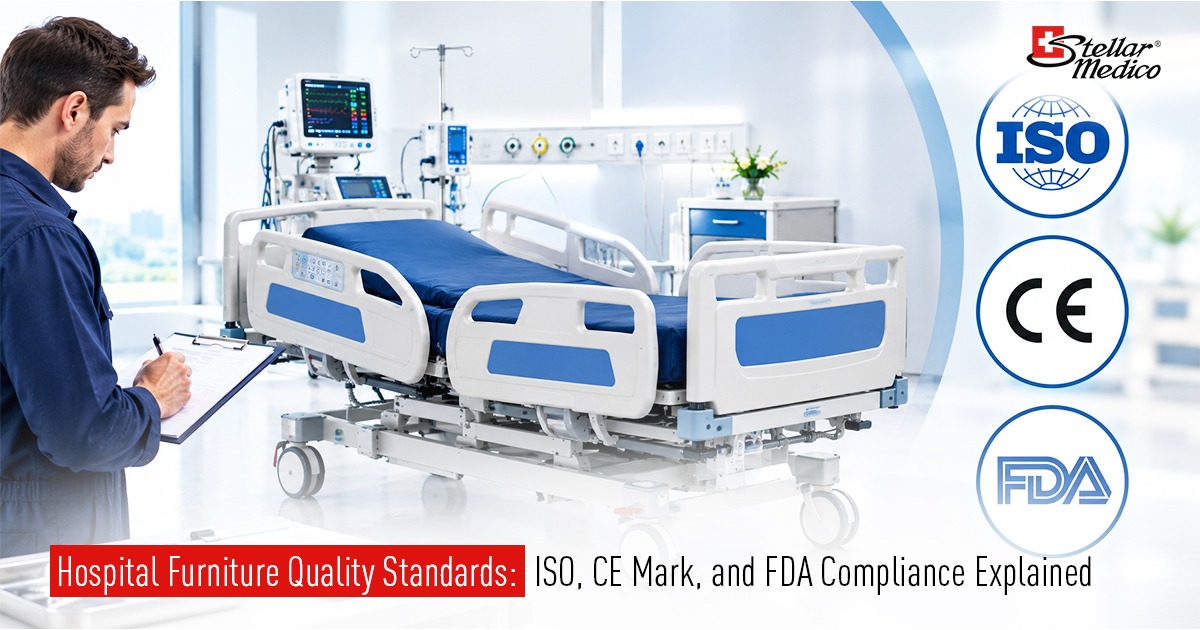
Certifications are often highlighted heavily in healthcare furniture marketing, and while they are important, they do not always tell the complete story.
Many certifications focus on manufacturing processes rather than product performance. This means a product can be certified but still fall short in real-world usage.
Hospitals should use a medical furniture buying guide to understand what each certification represents.
A well-prepared medical furniture checklist ensures that certifications are verified alongside actual product quality, durability, and usability.
Price is one of the most powerful tools in healthcare furniture marketing. Lower-cost options often attract attention, especially when budgets are tight.
However, cheap furniture often leads to frequent repairs, replacements and operational disruptions. Over time, this increases the total cost significantly.
A strategic medical furniture buying guide encourages hospitals to consider long-term value instead of just upfront cost.
By using a comprehensive medical furniture checklist, hospitals can evaluate durability, maintenance needs and lifecycle costs before making a purchase.
Many marketing materials focus on features but ignore how furniture fits into hospital workflows.
Furniture that does not align with staff movement, patient handling, or equipment placement can slow down operations and create inefficiencies.
This is where healthcare furniture marketing often falls short, it highlights specifications but overlooks usability.
A proper medical furniture buying guide emphasizes workflow compatibility.
A practical medical furniture checklist ensures that furniture supports efficiency rather than becoming an obstacle.
Hospitals require strict hygiene standards and furniture plays a critical role in maintaining them.
However, healthcare furniture marketing often highlights durability without addressing cleanability.
Furniture with complex designs, seams or poor-quality finishes can become difficult to clean and maintain.
Using a medical furniture buying guide, hospitals can evaluate how easy it is to clean and disinfect each product.
A well-defined medical furniture checklist ensures that hygiene is treated as a priority, not an afterthought.
Also Read: How Suppliers Help Hospitals Maintain Hygiene & Safety
Standard furniture solutions are widely promoted in healthcare furniture marketing, but they may not suit every hospital.
Different departments have different needs and a one-size-fits-all approach often leads to inefficiencies.
Customization allows hospitals to align furniture with their specific workflows, space constraints and operational requirements.
A strong medical furniture buying guide highlights when customization is necessary.
A detailed medical furniture checklist helps hospitals decide whether standard or customized solutions will deliver better results.
With so many claims in healthcare furniture marketing, choosing the right supplier becomes critical.
A reliable supplier does more than sell products, they help hospitals understand what to look for, what to avoid and how to make informed decisions.
Instead of relying on marketing claims, hospitals should use a medical furniture buying guide to evaluate suppliers.
A structured medical furniture checklist ensures that the supplier offers transparency, quality assurance, and reliable support.
Also Read: How Stellar Medico Ensures Quality as a Medical Furniture Supplier
To avoid falling for misleading healthcare furniture marketing, hospitals should shift their focus from claims to performance.
They should evaluate:
A well-defined medical furniture buying guide simplifies this process.
Using a practical medical furniture checklist ensures that every decision is based on real requirements rather than marketing promises.
The biggest lie in healthcare furniture marketing is not always a false statement, it is the assumption that all products deliver what they promise.
Hospitals that rely only on marketing claims often face early failures, higher costs, and operational inefficiencies.
The smarter approach is to look beyond labels and focus on real-world performance. A strong medical furniture buying guide combined with a detailed medical furniture checklist helps hospitals make informed, confident decisions.
Stellar Medico understands this reality. As a trusted supplier of medical furniture, we focus on delivering reliable, high-quality solutions that are built for actual healthcare environments, not just marketing claims.
If you are planning to upgrade your healthcare facility, make the right choice from the start.
Connect with us today and source medical furniture that delivers real performance, long-term durability and operational efficiency for your hospital.
The biggest issue is the gap between claims and actual performance. Many products are marketed as durable or hospital-grade, but they may not perform well in real healthcare environments. Hospitals must evaluate beyond marketing language.
Hospitals can avoid misleading claims by using a structured medical furniture buying guide and verifying product specifications, materials and performance rather than relying on promotional language.
A medical furniture checklist helps hospitals evaluate key factors such as durability, hygiene, design, and usability. It ensures that decisions are based on real requirements rather than assumptions.
Certifications are important but not sufficient on their own. They often focus on processes rather than product performance. Hospitals should combine certification checks with practical evaluation.
Hospitals should choose suppliers who offer transparency, quality assurance, and reliable products. A good supplier helps hospitals make informed decisions rather than relying solely on marketing claims.
Social Sharing: