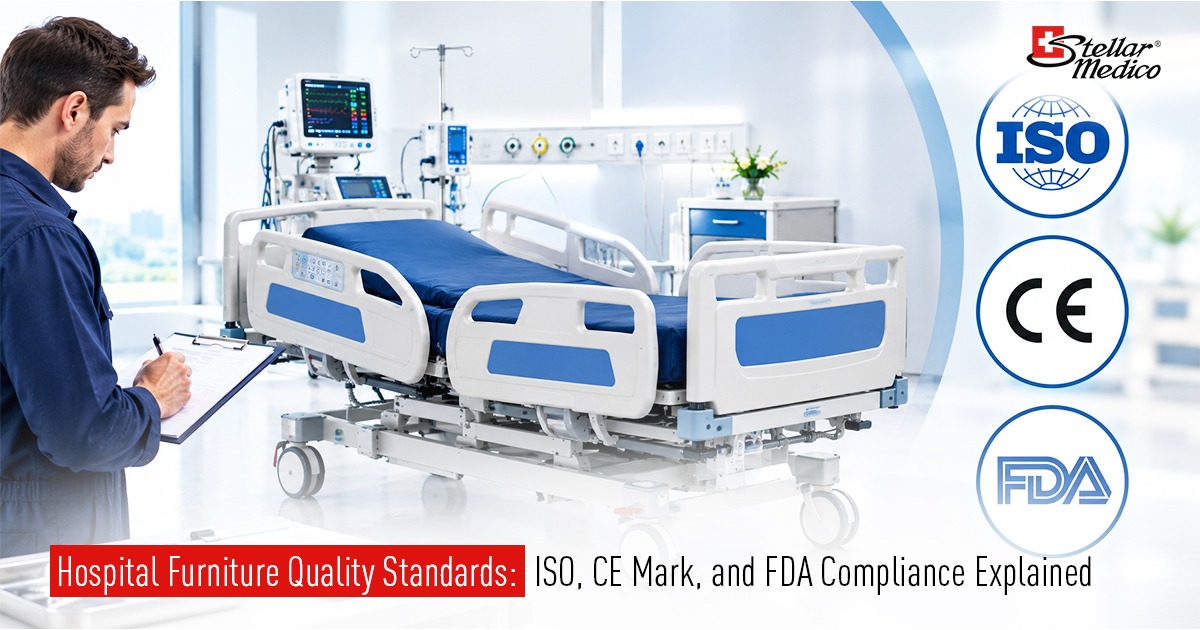
When hospitals purchase furniture, quality is often discussed in terms of materials, durability, functionality and price. But for projects involving medical devices or regulated products, another question matters just as much: does the product meet the standards and regulatory requirements that apply to it?
This is where hospital furniture quality standards can become confusing. ISO, CE marking and FDA requirements are often mentioned together, even though they serve different purposes and do not automatically apply to every type of hospital furniture.
For procurement teams, the goal should not simply be to collect as many certifications as possible. It is to understand which requirements apply to a particular product, what documentation should be available and how regulatory compliance relates to the intended market and use.
Why Hospital Furniture Quality Standards Matter
Hospital furniture operates in demanding environments. Products may be used continuously, moved frequently, exposed to cleaning agents and expected to support patients and healthcare professionals safely.
That makes hospital furniture quality standards an important part of supplier evaluation. They can provide a structured way to assess quality systems, product safety and applicable requirements rather than relying only on appearance or a product catalogue.
However, procurement teams should look beyond certification names. Product standards and regulatory requirements should always be considered according to the specific product and market.
A reliable supplier should also be able to provide clear information about applicable certifications, technical specifications and supporting documentation rather than making broad compliance claims.


ISO: What Does It Actually Tell You?
One of the most relevant standards in the medical-device sector is ISO 13485. It specifies requirements for a quality management system used by organizations involved in medical devices and related services. It focuses on processes that help organizations consistently meet customer and regulatory requirements.
This distinction is important when discussing ISO certification. ISO 13485 is primarily a quality-management-system standard; it is not a certificate stating that every individual piece of furniture automatically meets every possible requirement.
For procurement teams reviewing hospital furniture quality standards, ISO 13485 may therefore be useful when the relevant product falls within the medical-device framework and the organization supplying it has an applicable certified quality-management system.
ISO itself does not perform certification. Third-party certification can demonstrate that an organization has met the requirements of the standard.
What ISO 13485 Can Mean for Procurement Teams
A quality-management system can provide greater confidence that processes surrounding design, production, delivery and related activities are being controlled systematically.
This is one reason ISO certification can be relevant when evaluating suppliers of regulated medical products. ISO 13485 also places emphasis on risk management and regulatory requirements across the supply chain.
Still, procurement teams should avoid treating an ISO certification as a substitute for product-specific verification. The organization, product and intended use all matter.
In practical terms, good hospital furniture quality standards evaluation means asking what the certification covers, who holds it, whether it is current and whether it is relevant to the products being considered.
CE Marking: More Than a Quality Badge
CE marking is another term frequently encountered when hospitals source products for European markets. But CE marking should not simply be described as a general quality certification.
It indicates that a product falls within the scope of applicable EU legislation and that the relevant conformity requirements have been addressed. For medical devices, the EU Medical Device Regulation establishes requirements covering areas such as safety and performance, technical documentation and conformity assessment.
Therefore, CE certifications should be evaluated in context. Procurement teams need to establish whether the particular furniture or medical device is actually within the scope of CE requirements and what conformity assessment applies.
This is an important part of understanding regulatory compliance rather than simply checking whether a CE symbol appears in a brochure.
What Should Hospitals Check About CE?
When CE marking is relevant, hospitals should ask for appropriate supporting documentation rather than relying on the marking alone.
Depending on the product and applicable legislation, this can include a Declaration of Conformity and technical information supporting the manufacturer’s conformity assessment.
This makes product standards and documentation especially important during procurement. The objective is to verify that the claim relates to the actual product being purchased and the market in which it will be supplied.
For international projects, these checks can form an important part of broader hospital furniture quality standards evaluation.
FDA Compliance: When Does It Apply?
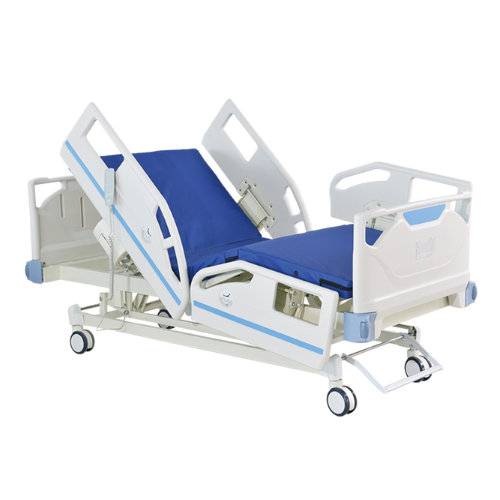
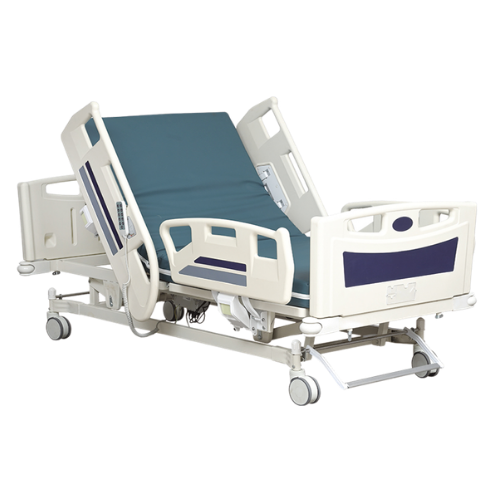
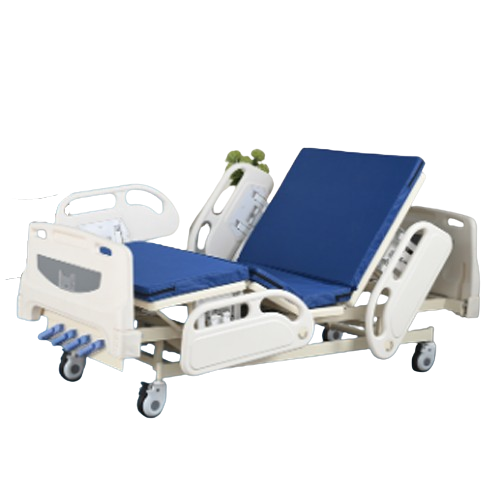
FDA requirements are similarly product and market-specific. The U.S. Food and Drug Administration regulates medical devices and other healthcare products that fall within its jurisdiction. Hospital beds, for example, are addressed by the FDA as medical devices, with different classifications applying to different products.
This means hospitals should not assume that every hospital furniture product needs FDA clearance or approval.
For products that are regulated as medical devices in the United States, applicable FDA requirements may include product-specific controls, registration or listing requirements, quality-system obligations and other regulatory provisions depending on the device.
Understanding this distinction is essential to accurate regulatory compliance.
Hospital Beds Show Why Product-Specific Requirements Matter
Hospital beds are a useful example of why hospital furniture quality standards cannot be treated as a single checklist.
The FDA has issued guidance addressing hospital bed systems and entrapment risks, including dimensional considerations involving bed frames, mattresses, side rails and accessories.
This illustrates an important procurement principle: safety requirements can relate to how a product is designed and used, not simply whether a supplier holds a particular certificate.
When evaluating patient beds, procurement teams should therefore examine relevant product standards, safety information, intended use and supporting documentation alongside broader supplier credentials.
ISO, CE and FDA Are Not the Same Thing
One of the easiest mistakes in healthcare procurement is treating ISO, CE and FDA as three versions of the same certification.
They are not!
ISO certification generally relates to a management system when a relevant ISO standard applies. CE marking relates to conformity with applicable European legislation. FDA requirements apply to products regulated by the U.S. authority and depend on the product and its intended use.
That difference matters because regulatory compliance is not achieved by collecting certificates indiscriminately.
The right question is not, “Does this supplier have ISO, CE and FDA?” It is, “Which requirements apply to this product, this intended use and this target market?”
What Procurement Teams Should Ask Suppliers
A practical evaluation of hospital furniture quality standards should begin with a few straightforward questions.
Ask which standards and regulations apply to the product. Request relevant certifications, declarations or technical documentation where applicable. Check the name of the organization covered by the document and whether the scope matches the product being purchased.
Procurement teams should also ask about materials, dimensions, load requirements, cleaning compatibility, intended use and maintenance considerations.
These questions help connect product standards with the actual requirements of the hospital instead of treating documentation as a box-ticking exercise.
Don’t Confuse Supplier Credentials With Product Compliance
Another important distinction is between a supplier’s credentials and the compliance status of an individual product. A supplier may have experience working with healthcare projects, while specific products may have different standards, classifications or documentation requirements.
This is particularly relevant when working with hospital furniture suppliers on large projects involving multiple product categories.
Experienced medical furniture suppliers clearly communicate what documentation is available for the products they supply and what requirements apply to the intended market.
For specialized projects, healthcare furniture suppliers may also need to coordinate product-specific documentation across multiple categories.
A Better Way to Evaluate Quality
The strongest procurement decisions combine documentation with practical product evaluation.
Look at the applicable hospital furniture quality standards, but also consider construction, materials, functionality, durability, cleanability, safety features and suitability for the intended clinical environment.
Where relevant, review ISO certification, CE documentation or FDA-related information as part of the overall assessment rather than treating any single credential as proof of universal compliance.
This approach creates a more realistic picture of quality and regulatory compliance.
For products such as patient beds and accessories, procurement teams can also work with patient beds and accessories suppliers to understand the specific documentation and product requirements relevant to their project.
What About International Sourcing?
International hospital projects may involve suppliers and manufacturers operating across different markets. This makes it even more important to identify the destination market before evaluating compliance requirements.
A requirement applicable in the European Union may differ from one applicable in the United States or another jurisdiction. Product standards should therefore be checked against the actual market and intended use.
Procurement teams considering hospital equipment suppliers China, for example, should not assume that a document issued for one market automatically satisfies another market’s requirements.
The same principle applies to medical equipment furniture suppliers working on projects involving equipment-specific furniture or supporting systems.
The Supplier’s Role in a Compliant Procurement Process
Suppliers play an important role in helping procurement teams access accurate product information, specifications and available documentation. However, the supplier should not be treated as the authority that determines every regulatory requirement for the hospital.
Hospitals should establish their own project and market requirements and then ask suppliers to provide the relevant supporting information.
For hospital furniture quality standards, this creates a more transparent procurement process: define what is required, identify what applies to each product, verify the documentation and then assess the product’s suitability.
That is far more useful than selecting products based on certification logos alone.
Choosing a Supplier With the Right Approach
Quality in healthcare furniture is about more than a certificate on paper. It is about whether the products are suitable for their intended environment and whether the information supporting them is clear, relevant and verifiable.
At Stellar Medico, we supply furniture solutions for healthcare environments and support procurement teams with product information relevant to their requirements.
If your hospital is evaluating furniture for a new project, expansion or upgrade, connect with us to discuss your requirements and source dependable medical furniture solutions with the product information and documentation needed for a more informed procurement decision.
FAQs
1. Are ISO, CE and FDA requirements mandatory for all hospital furniture?
No. Their applicability depends on the product, intended use and target market. Hospital furniture quality standards should therefore be evaluated product by product rather than assuming that every item needs all three.
2. Does ISO 13485 certification mean that every product is automatically compliant?
No. ISO 13485 addresses a quality management system for organizations involved with medical devices and related services. An ISO certification does not by itself establish that every product meets every applicable regulatory or product standards requirement.
3. Is CE marking the same as a quality certification?
No. CE marking relates to conformity with applicable EU legislation. Whether it applies to a particular hospital furniture product depends on its classification and intended use. Procurement teams should verify the relevant documentation instead of treating CE as a universal quality label.
4. Do hospital beds have FDA requirements?
Some hospital beds are regulated by the FDA as medical devices in the United States. FDA guidance also addresses hospital bed system safety, including entrapment risks. Applicable requirements should be verified according to the specific product and intended use.
5. What should hospitals ask a medical furniture supplier about compliance?
Hospitals should ask which hospital furniture quality standards apply, what relevant certifications or documentation are available, and whether the documents correspond to the actual product and target market. They should also review specifications, safety information and intended use before finalizing procurement.
Social Sharing: