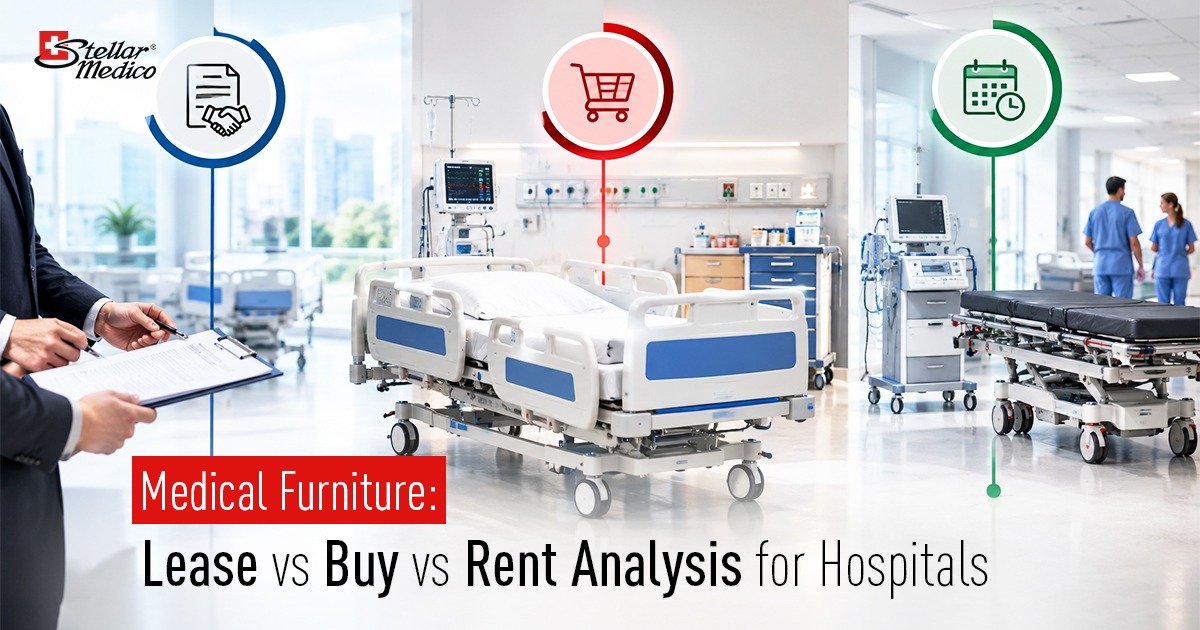
Hospital furniture is a long-term operational investment, but not every requirement needs to be acquired in the same way. Hospitals may purchase furniture for permanent use, while leasing or renting can be considered when a requirement is temporary or capital availability is limited.
When evaluating medical furniture financing options, procurement teams need to look beyond the initial quotation. The duration of use, frequency of use, maintenance responsibilities, available capital and future requirements can all influence the most practical approach. The objective is not simply to find the cheapest option, but to choose an acquisition model that makes sense for the hospital’s actual needs.
At a basic level, buying means the hospital purchases and owns the furniture. Leasing provides access to furniture for an agreed contractual period, while renting is generally associated with shorter-term requirements.
The relevance of these medical furniture financing options depends heavily on the project. Permanent inpatient departments have very different requirements from temporary facilities, renovation phases or short-term capacity expansion.
For procurement teams, the first question should therefore be simple: how long will the furniture actually be needed? Establishing this early can make the rest of the decision much clearer.
For furniture expected to remain in use for several years, purchasing can be a straightforward and practical approach. Once the hospital owns the furniture, it can determine how the products are used, maintained, relocated and eventually replaced without being tied to a rental or lease period.
Patient beds, bedside units, examination furniture, nursing stations, storage systems and other frequently used products can represent permanent infrastructure. For these requirements, furniture leasing may not necessarily offer an advantage when the hospital already knows the furniture will be needed for many years.
A proper purchasing vs leasing assessment should therefore consider expected service life rather than simply comparing the initial payment. If furniture is likely to be used continuously for a long period, ownership can become more attractive over its useful life.
The larger upfront investment remains an important consideration. This is where medical furniture financing options become relevant for hospitals balancing furniture requirements with construction, equipment and other capital expenditure.
Leasing can be considered when a hospital wants to spread expenditure over an agreed period instead of making the entire payment upfront. This may be relevant when a facility is managing several competing investments at the same time.
However, furniture leasing should never be evaluated on the monthly payment alone. Procurement teams should understand the complete contractual cost, duration, maintenance responsibilities, ownership conditions and end-of-term provisions.
The expected period of use also matters. If a hospital expects to continue using the furniture long after the lease ends, purchasing vs leasing becomes a more important comparison.
A lower immediate financial commitment does not automatically translate into a lower overall cost. Medical furniture financing options should therefore be evaluated against the actual period for which the furniture is expected to remain useful.
Renting is generally more relevant when the furniture requirement is temporary. A hospital undergoing renovation, managing a short-term increase in capacity or replacing furniture during a transition may not want to permanently increase its inventory.
For such situations, renting can provide flexibility without creating a long-term ownership commitment. However, procurement teams still need to understand delivery, collection, maintenance and any additional charges associated with the arrangement.
These budget alternatives can be useful when a requirement has a clearly defined end point. They may also be considered when future demand is uncertain and committing capital to permanent furniture may not be practical.
At the same time, budget alternatives should not be selected simply because they appear inexpensive at first. The complete cost needs to be considered against the duration and intensity of use.
A meaningful cost comparison should consider the complete expense associated with each acquisition approach. Purchase price or monthly payment is only one part of the equation.
Hospitals may need to account for delivery, installation, maintenance, repairs, replacement components, storage, relocation and eventual disposal. With leased or rented furniture, contractual charges and end-of-term conditions can also influence the final cost.
This broader cost comparison becomes particularly important in large hospital projects, where even relatively small differences across a high volume of furniture can have a noticeable financial impact.
For teams reviewing medical furniture financing options, one practical question can help: what will this furniture actually cost the hospital over the period it is expected to be used?
A furniture requirement lasting six months is very different from one expected to remain in a hospital ward for ten years.
This is why purchasing vs leasing needs to be approached according to the expected period of use. Ownership may become more attractive when utilization is high and the furniture has a long service life, while temporary arrangements may offer greater flexibility when requirements are short-term.
The same principle applies to furniture leasing. A lease can help distribute expenditure, but its overall value depends on how the contract period compares with the actual requirement.
Before selecting among medical furniture financing options, hospitals should establish realistic usage periods for each major furniture category rather than applying one acquisition model across the entire facility.
Duration is only one side of the decision. How heavily the furniture will be used matters just as much.
A patient bed in a busy inpatient department may be used far more intensively than furniture in a low-traffic administrative area. Clinical furniture can also be exposed to frequent cleaning, movement, repositioning and repeated handling.
These factors should be considered during cost comparison and lifecycle planning. A heavily used product needs to be evaluated for durability, maintenance requirements and expected service life rather than its acquisition cost alone.
For high-utilization environments, purchasing may make sense when the furniture is expected to remain in service for many years. For temporary requirements, budget alternatives may provide greater flexibility.
Maintenance is often overlooked when hospitals compare acquisition models. Furniture remains part of the healthcare environment long after delivery, and responsibility for repairs, servicing and replacement components can vary depending on the arrangement.
When reviewing furniture leasing, hospitals should establish who is responsible for routine maintenance and what happens when a component requires replacement.
The same issue matters in a purchasing vs leasing review. With purchased furniture, the hospital generally manages its own maintenance arrangements, while contractual models may assign certain responsibilities differently.
A realistic cost comparison should therefore include maintenance and service responsibilities rather than treating the furniture price as the entire expense.
Furniture decisions rarely happen in isolation. A new hospital may simultaneously require construction, medical equipment, technology and other infrastructure. Existing facilities may be managing renovations, expansions or phased upgrades.
This makes medical furniture financing options relevant from a capital-planning perspective. Purchasing outright may require greater expenditure at the beginning, while other acquisition approaches can distribute payments over time.
However, preserving capital should not come at the expense of product suitability. Furniture still needs to meet the functional requirements of the department where it will be used.
The most useful budget alternatives are therefore those that balance financial flexibility with actual operational requirements.
One practical way to approach the decision is to divide furniture requirements into permanent and temporary categories.
Permanent requirements include products that form part of the hospital’s ongoing infrastructure. Temporary requirements may relate to renovation periods, interim capacity, short-term expansion or transitional arrangements.
This distinction can simplify the evaluation of medical furniture financing options, because the acquisition approach can be considered according to the purpose of the furniture.
For permanent requirements, purchasing may deserve serious consideration. For temporary needs, renting or furniture leasing may offer flexibility depending on the circumstances and contractual terms.
This approach also prevents hospitals from forcing every furniture requirement into the same procurement model.
A monthly payment can make an arrangement appear affordable, but it does not necessarily reflect its total financial impact.
A proper cost comparison should calculate the total amount payable over the expected usage period and account for additional charges wherever applicable.
The same principle applies to purchasing vs leasing. A lower initial commitment may result in a higher overall cost over time, while purchasing may require more capital upfront but eliminate recurring contractual payments.
For this reason, medical furniture financing options should be assessed according to total value rather than headline pricing.
Before making a decision, procurement teams should establish how long the furniture will be required, how heavily it will be used and whether the requirement is permanent or temporary.
They should then review acquisition or contract costs, maintenance, replacement requirements, delivery, installation and any contractual obligations. This provides a stronger basis for cost comparison than simply comparing quotations.
Hospitals should also consider whether furniture specifications are likely to remain suitable if a department expands or its requirements change. Flexibility can have value, particularly in facilities undergoing phased development.
When reviewing budget alternatives, procurement teams should consider both the immediate requirement and the likely operational needs of the coming years.
Regardless of the acquisition approach, product suitability remains fundamental. A flexible payment arrangement cannot compensate for furniture that is unsuitable for its intended healthcare environment.
Working with established hospital furniture suppliers can give procurement teams access to the product information, specifications and availability needed to assess their requirements properly.
Experienced medical furniture suppliers can provide different furniture categories for clinical and operational areas, allowing hospitals to evaluate products according to their intended application.
For specialised requirements, hospitals may also work with healthcare furniture suppliers or patient beds and accessories suppliers, depending on the scope of the project.
Large institutional projects may separately evaluate medical equipment furniture suppliers where furniture needs to accommodate specific equipment or workflows.
International sourcing may also be considered where appropriate, including options involving hospital equipment suppliers China, depending on project requirements and procurement policies.
The key is to keep supplier evaluation focused on product suitability, quality, specifications, availability and supply capability.
There is no universal answer to the buy-versus-lease-versus-rent question. The most suitable approach depends on how long the furniture is needed, how intensely it will be used, how much capital is available and how much flexibility the hospital requires.
For long-term, predictable requirements, purchasing can offer the advantages of ownership and continued use. Furniture leasing may be considered when spreading expenditure is important, while renting can be relevant for clearly temporary requirements.
Ultimately, purchasing vs leasing should be evaluated alongside the actual circumstances of the project rather than treated as a simple price comparison.
The purpose of reviewing medical furniture financing options is not to identify one model that works for every hospital. It is to understand the available approaches and determine which one aligns with the hospital’s operational and financial requirements.
The acquisition approach is only one part of a successful furniture investment. The products themselves must be suitable for their intended environment, available in the required quantities and capable of supporting long-term hospital operations.
This is where Stellar Medico comes in as a medical furniture supplier. We supply reliable medical furniture solutions for hospitals and healthcare environments, with products suited to a range of clinical and operational requirements.
Whether your hospital is setting up a new facility, expanding an existing one, renovating a department or upgrading its furniture infrastructure, connect with us today to source dependable medical furniture solutions suited to your project’s requirements and built to support reliable healthcare operations.
1. Is buying medical furniture always better than leasing or renting?
Not necessarily. Buying can be practical when furniture is required for many years and the hospital has sufficient capital for the initial investment. Leasing or renting may be considered when flexibility or shorter-term access is more important. The decision should be based on duration, utilization and total cost rather than the acquisition method alone.
2. When can renting medical furniture make sense for a hospital?
Renting may be considered when furniture is required temporarily, such as during a renovation, short-term capacity expansion or an interim replacement period. It can help avoid permanently increasing inventory for a requirement with a defined end point. Hospitals should still review delivery, collection, maintenance and other applicable costs before deciding.
3. What should hospitals consider when evaluating furniture leasing?
Hospitals should look beyond the monthly payment and examine the complete contractual cost. Duration, maintenance responsibilities, repair provisions, ownership conditions, renewal terms and end-of-term requirements should be clearly understood. Comparing these factors with purchasing can provide a more realistic view of the arrangement.
4. How should hospitals compare buying, leasing and renting?
The comparison should use the same expected period of use wherever possible. Procurement teams should consider acquisition or contract costs, maintenance, repairs, replacement requirements, delivery, installation and other applicable expenses. This gives hospitals a clearer understanding of which approach is financially and operationally suitable.
5. Does the acquisition model affect the choice of medical furniture supplier?
The acquisition model and supplier selection are separate decisions, but both influence the overall procurement process. Hospitals should evaluate product specifications, quality, availability, consistency and supplier reliability regardless of how the furniture is acquired. A dependable supplier helps ensure that the furniture itself remains suitable for the intended healthcare environment.
Social Sharing: