A hospital bed used to be viewed mainly as a place for a patient to rest, recover and receive care. That is changing, as hospitals become increasingly connected, the bed is beginning to play a more active role within the clinical environment. Sensors, wireless connectivity and digital monitoring systems can turn a conventional-looking bed into a source of useful information about patient movement, bed occupancy and other aspects of patient care.
This is where smart hospital beds IoT integration is gaining attention in 2026. Rather than functioning as an isolated piece of furniture, connected beds can become part of a wider digital healthcare ecosystem.
But what does that actually mean for hospitals and what should procurement teams understand before considering connected medical furniture?
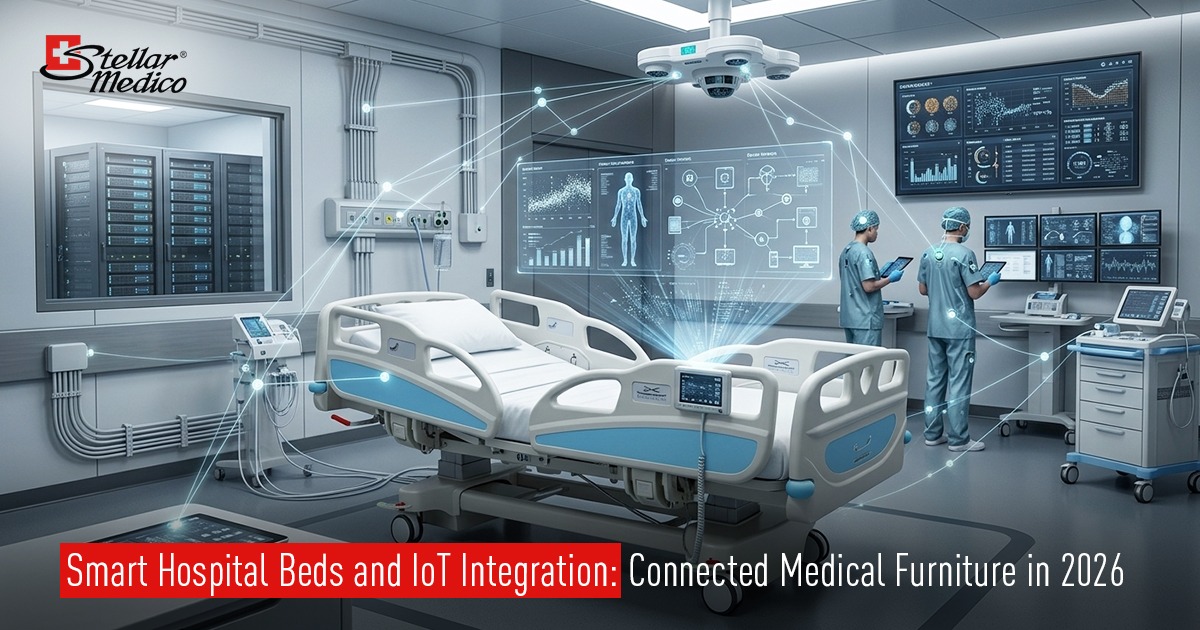
A smart hospital bed combines conventional bed functions with sensors, connectivity or digital systems that can collect and transmit information.
Depending on the system, sensors may detect whether a patient is in bed, sitting up or attempting to leave. Other systems can capture movement, pressure distribution or weight-related information. Research has also explored beds that connect patient-monitoring sensors with hospital information systems.
This is the foundation of smart hospital beds IoT technology.
The important point is that “smart” does not describe one standard feature set. Different products can offer very different capabilities, so hospitals need to evaluate what the technology actually measures, where the information goes and how it fits into existing workflows.
Hospitals already use multiple digital systems to support patient care. The next step is increasingly about connecting information from different points within the care environment.
This is where connected furniture can become useful. Instead of requiring every observation to come from a separate device or manual check, selected information generated around the bed can potentially be shared with caregivers through connected systems.
For example, research has demonstrated IoT-based bed-exit monitoring that can send alerts to nursing staff through mobile devices and dashboards.
The value of healthcare technology therefore isn’t simply adding sensors to furniture. It is about making useful information available at the right time.
One of the most established applications of smart hospital beds IoT technology is bed-exit monitoring.
Sensors positioned within or around the bed can identify changes in patient position and trigger an alert when a patient appears to be attempting to leave the bed. This can be particularly relevant for patients who may be at increased risk of falling.
Some studies of integrated IoT patient-care systems reported a significant reduction in bedside falls in the ward using the system, although the researchers also noted that further research is needed.
This illustrates an important point: patient monitoring beds can support clinical teams, but they are not substitutes for professional assessment or nursing care.
The capabilities of connected furniture can extend beyond simple bed-exit alerts.
Research has explored pressure sensors, movement detection, weight sensing and other forms of data collection from beds and mattresses. Some experimental systems have also investigated respiratory and heart-rate monitoring.
These developments are expanding the potential role of patient monitoring beds within hospitals.
At the same time, hospitals need to distinguish between technologies that are commercially established and those that remain research or development projects. Not every feature demonstrated in research is automatically available as a hospital-ready product.
The “connected” part of smart hospital beds IoT depends on more than sensors.
Data generally needs to move from the bed or mattress to a gateway, network or software platform before it can reach a dashboard or another hospital system. Research has demonstrated architectures in which bed-based sensors communicate wirelessly with gateways and hospital information systems. This makes interoperability an important consideration.
A hospital investing in connected furniture should therefore ask whether the system can work with the digital infrastructure already in place. A technically advanced bed that operates in isolation may provide less practical value than a simpler system that integrates reliably into existing workflows.
Technology is useful only when it helps staff rather than creating another layer of work.
A well-designed healthcare technology system can send relevant alerts to the appropriate caregiver, potentially helping staff respond more quickly to specific events. Research into IoT bed monitoring has shown that alerts can be delivered through dashboards and mobile devices.
However, poorly designed alert systems can create another problem: alarm fatigue.
That means smart hospital beds IoT systems need to be evaluated not only for what they can detect, but also for how alerts are generated, prioritized and communicated.
Another potential application of patient monitoring beds is understanding how a patient is positioned or how pressure is distributed across the mattress.
Pressure-sensing technologies have been investigated for identifying prolonged pressure areas and supporting repositioning. Some smart mattress systems can provide information about patient position and movement over time.
For hospitals, this could support more informed observation of patients who spend extended periods in bed.
But again, technology should be viewed as a support mechanism. Clinical protocols and professional judgment remain central to patient care.
The arrival of smart hospital beds IoT technology changes the procurement conversation.
Hospitals may increasingly need to evaluate beds not only for dimensions, load capacity, positioning and mobility, but also for connectivity, sensors, software compatibility and data handling where these features are required.
This makes connected furniture a broader procurement consideration rather than simply a technology upgrade.
Procurement teams should ask what the bed actually does, what information it collects, how that information is transmitted and what infrastructure is required to operate it.
There is a natural temptation to assume that more technology automatically means better furniture.
It doesn’t.
A hospital should first identify the clinical and operational problem it wants to solve. If bed-exit monitoring is the priority, the relevant system should be assessed for detection reliability, alert handling and workflow integration. If the requirement is pressure monitoring, different capabilities may be more relevant.
This is where healthcare technology needs to be evaluated against actual hospital requirements rather than novelty.
The best smart hospital beds IoT solution is not necessarily the one with the longest list of features. It is the one that provides useful functionality without creating unnecessary complexity.
Once furniture becomes connected, it also becomes part of the hospital’s broader digital environment.
That introduces questions around network compatibility, access controls, data security, software maintenance and system reliability. Hospitals should involve their relevant IT, clinical engineering and procurement teams before deploying connected systems at scale.
The same applies to patient monitoring beds. If a bed generates patient-related information, hospitals need to understand how that information is handled and protected. Technology planning therefore needs to happen alongside furniture procurement, not after installation.
For hospitals considering smart hospital beds IoT, the starting point should be the use case.
Evaluate the clinical requirement, sensor capabilities, connectivity, interoperability, alert functionality, maintenance needs and staff workflow. Also consider what happens if the network or connected system becomes unavailable.
For connected furniture, reliability should remain as important as innovation.
Hospitals should also consider whether their existing infrastructure can support the technology and whether staff will be able to use it effectively without unnecessary complexity.
The direction is clear: medical furniture is becoming increasingly connected to the wider healthcare environment.
Research already demonstrates the potential of smart hospital beds IoT systems for bed-exit monitoring, movement detection and integration with hospital information systems.
But the future of connected furniture will depend on practical integration. Sensors alone do not improve care. Their value comes from reliable information, useful alerts and systems that fit naturally into clinical workflows.
For hospitals, that means the conversation around beds is gradually expanding from physical furniture to furniture that can participate in a connected care environment.
As hospitals explore smarter infrastructure, the fundamentals of medical furniture selection still matter: appropriate specifications, dependable products, suitability for the intended environment and reliable supply.
At Stellar Medico, we operate as a medical furniture supplier, providing furniture solutions for healthcare environments and supporting hospitals with products suited to their project requirements.
If you’re planning a new hospital, upgrading patient-care areas or evaluating the next generation of medical furniture, connect with Stellar Medico today to discuss your requirements and source dependable furniture solutions for modern healthcare environments.
Social Sharing: